







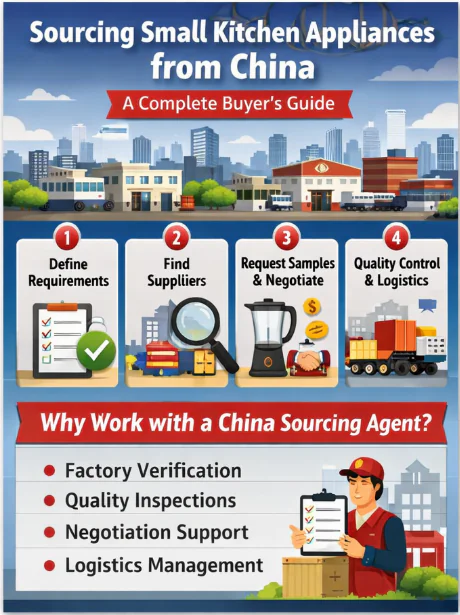
The global market for small kitchen appliances continues to expand rapidly. From air fryers and electric kettles to blenders and rice cookers, consumers worldwide are upgrading their kitchens at a pace that keeps importers and retailers in a constant search for reliable supply. China remains the world’s dominant manufacturer of small kitchen appliances — competitive factory pricing, massive production capacity, and a supplier ecosystem that can accommodate everything from private label orders to full OEM development.
But sourcing from China is not without its challenges. Navigating thousands of suppliers, verifying quality, managing logistics, and protecting your brand all require experience and local knowledge. This guide walks you through the essential steps of sourcing small kitchen appliances from China — and explains why working with a professional China sourcing agent can make all the difference.
Why China Is the Go-To Source for Small Kitchen Appliances
China has built an unparalleled infrastructure for manufacturing small household appliances. Major production hubs like Guangdong, Zhejiang, and Jiangsu are home to thousands of specialized factories producing everything from single-function gadgets to multi-purpose kitchen systems. The sheer density of suppliers in these regions means buyers can find almost any product specification, at almost any price point, with MOQs ranging from a few dozen units to full container loads.
Beyond volume, Chinese manufacturers have significantly improved their quality standards over the past decade. Many factories now hold certifications such as CE, RoHS, ETL, and UL, enabling their products to enter markets in Europe, North America, Australia, and beyond. For importers, this means you can find kitchen appliances that meet your destination market’s regulatory requirements without managing complicated third-party testing from scratch.
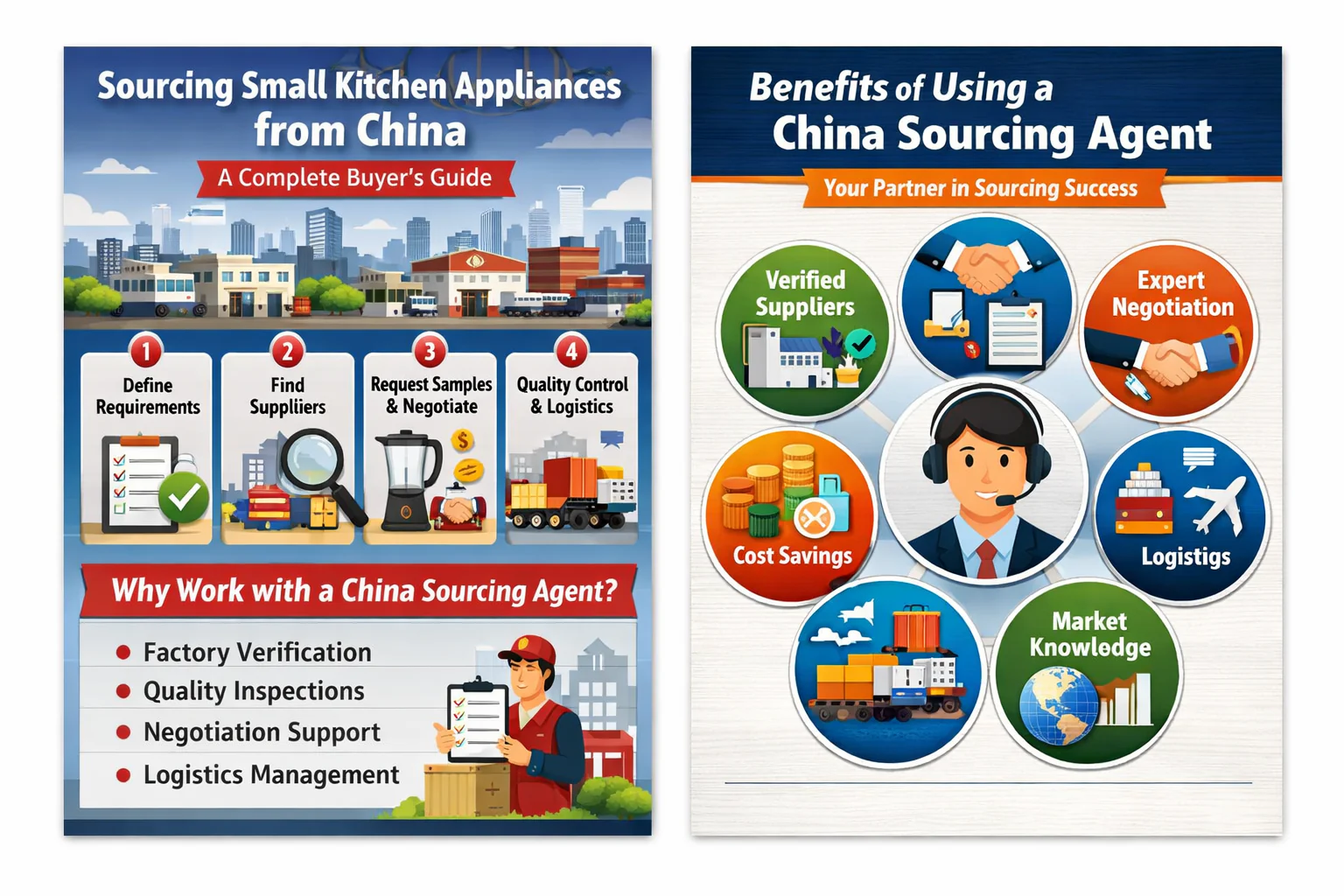
Step 1: Define Your Product Requirements Clearly
Before reaching out to any supplier, you need a clear product brief. For small kitchen appliances, this means specifying the voltage and plug standard for your target market (110V/60Hz for North America, 220V/50Hz for Europe), required safety certifications, desired materials and finishes, packaging requirements, and any branding or labeling needs. The more precise your specifications upfront, the easier it is to get accurate quotes and minimize costly revisions later in the process.
It also helps to know your target retail price. Working backward from what consumers will pay in your market gives you a clear budget ceiling for factory pricing, allowing you to evaluate quotes realistically rather than optimistically.
Step 2: Find and Verify Suppliers
Online platforms like Alibaba and Made-in-China are common starting points, but they come with significant limitations. Product listings are often not verified for accuracy, factory audit data can be outdated, and the sheer number of trading companies masquerading as manufacturers makes it hard to know who you’re actually dealing with. Many buyers have placed orders based on impressive-looking listings only to receive products that bear little resemblance to the approved sample.
This is where a local China sourcing agent adds immediate value. A qualified sourcing agent has on-the-ground access to factories, can conduct in-person audits, verify production capacity, and confirm that the supplier is actually manufacturing the product rather than brokering it through another factory. For small kitchen appliances specifically — which involve electrical safety — supplier verification is not optional.
Step 3: Request Samples and Negotiate Terms
Never skip the sample stage. For kitchen appliances, samples allow you to evaluate build quality, test functionality, assess packaging durability, and check whether safety certifications match what is claimed. A sample that fails basic operational testing before the order is placed can save you from a much larger problem after 5,000 units arrive at your warehouse.
During negotiation, pay attention not just to unit price but to payment terms, lead time, and what happens when products fail inspection. Reputable factories will agree to clearly defined quality standards in writing and accept third-party quality control inspections before shipment. If a supplier resists this, treat it as a warning sign.
Step 4: Manage Quality Control
Quality control for small kitchen appliances should happen at multiple points: pre-production to verify raw materials, during production to catch issues early, and pre-shipment to inspect finished goods. A professional sourcing agent will coordinate these inspections on your behalf, provide detailed QC reports with photographic evidence, and flag any non-conformances before goods are loaded.
For electrical products destined for regulated markets, pre-shipment inspection should also include verification of certification markings, labeling compliance, and correct voltage ratings. A single mislabeled unit can trigger a product recall that far exceeds the value of the original order.
Step 5: Logistics and Customs
Small kitchen appliances are generally shipped by sea in full container loads (FCL) or less-than-container loads (LCL), depending on order volume. Air freight is an option for smaller, high-value orders or urgent replenishments. Your sourcing agent should be able to coordinate freight forwarding, prepare export documentation, and advise on customs classification and import duties for your destination market.
Working with a sourcing company that has overseas warehousing — particularly in key markets like the United States — can significantly speed up last-mile distribution and reduce the risk of border delays affecting your inventory levels.
Why Work With a Professional China Sourcing Agent?
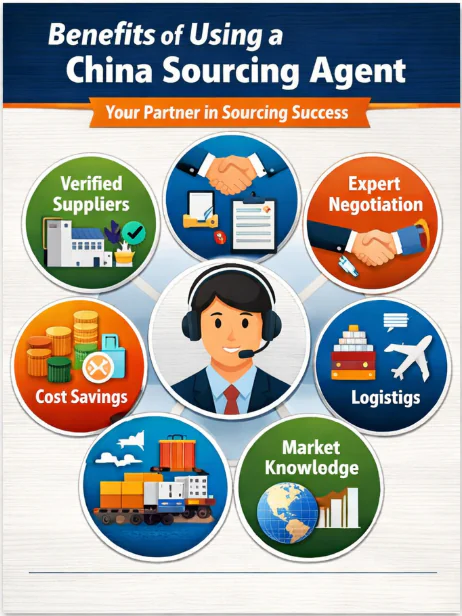
For importers who are new to China sourcing or who are expanding into new product categories, the learning curve is steep and the cost of mistakes is high. A professional sourcing agent like IHome brings over 20 years of export experience, a verified factory network, in-house QC teams, and multilingual support across English, Russian, Spanish, and more.
Rather than spending months vetting suppliers, managing sample rounds, and learning Chinese logistics from scratch, you can leverage an established infrastructure that has already processed thousands of successful orders for international clients. IHome’s offices in Ningbo, Yiwu, and Shantou, combined with overseas warehousing in Los Angeles, New Jersey, and Atlanta, position the company to support both sourcing and distribution for clients across North America, Europe, and beyond.
If you are ready to source small kitchen appliances from China, contact IHome’s sourcing team at www.ihomechinabuy.com. Share your product requirements, target market, and budget, and IHome will identify matched suppliers, provide competitive pricing, and guide you through the entire process from first inquiry to doorstep delivery.
Sourced by IHome — Your Trusted China Sourcing Agent | www.ihomechinabuy.com

Kelsey Sun is a China procurement expert with over 8 years of experience in cross-border sourcing and supply chain management. As a Senior Sourcing Specialist at iHomeChina, she has successfully connected hundreds of international businesses with vetted Chinese manufacturers. Kelsey specializes in supplier verification, quality control, and multi-factory consolidation strategies, with deep expertise in both major B2B platforms like Alibaba and China’s network of high-quality manufacturers who lack international visibility.