








If you’re sourcing from China for the first time, you’ve probably seen this in every supplier conversation: “30% deposit, 70% before shipment.”
It’s the default. It’s everywhere. But what does it actually mean for your money — and your risk?
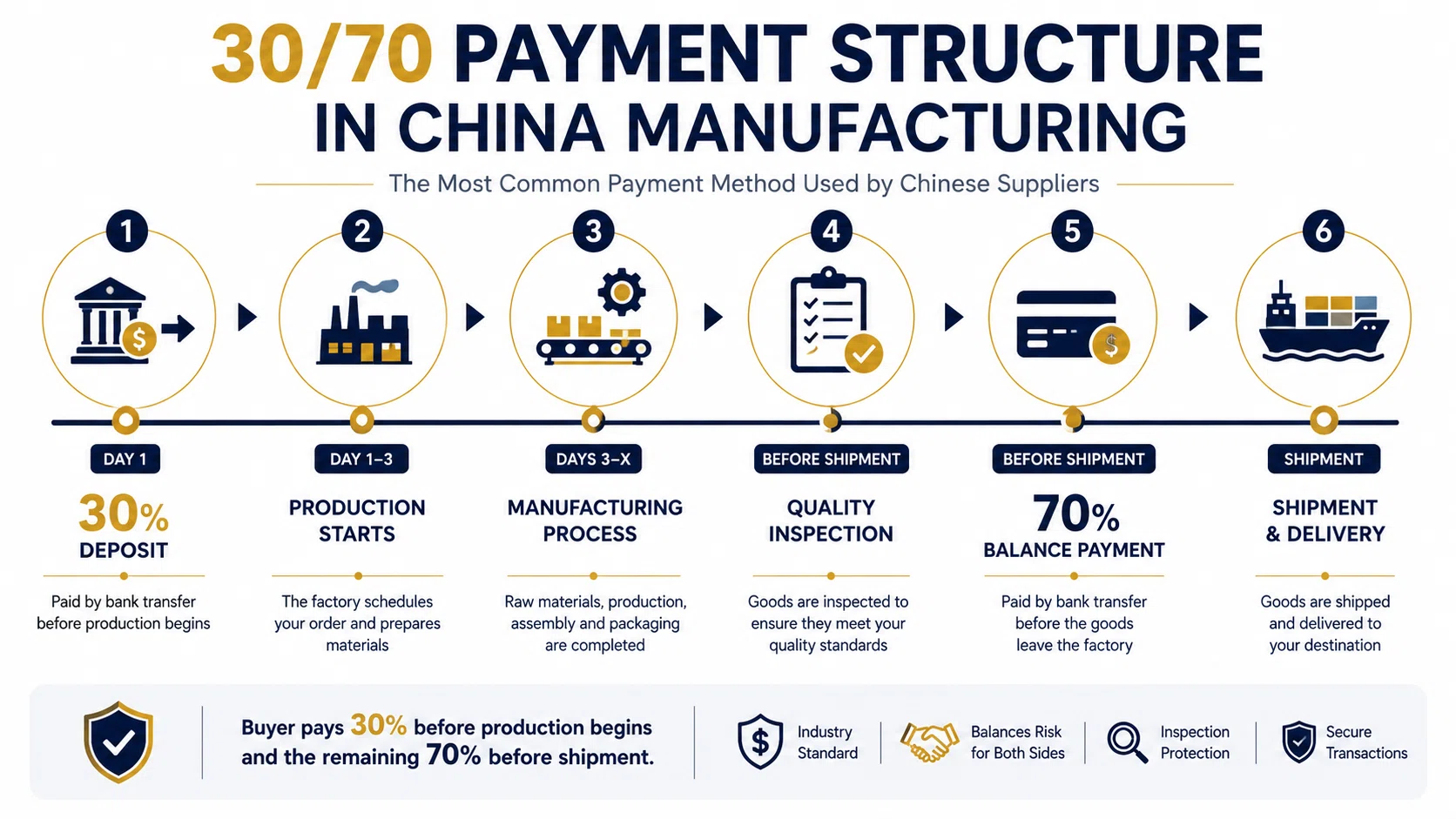
Here’s the short answer: 30/70 T/T is the standard payment structure in Chinese manufacturing, where you pay 30% of the total order value upfront before production starts, and the remaining 70% before the goods leave the factory. It’s simple, widely accepted, and — when handled correctly — a workable system for both sides.
But “standard” doesn’t mean “risk-free.” Let’s break down exactly how it works, when it makes sense, and how to protect yourself.
What Is 30/70 Payment? The Basic Structure
The 30/70 payment term — also written as “30/70 T/T” or “30% deposit, 70% before shipment” — is a two-stage payment arrangement:
| Stage | Percentage | When You Pay | What It Covers |
| Deposit | 30% | Upon signing the contract, before production begins | Raw materials, initial labor, factory scheduling |
| Balance | 70% | After production is complete, before goods are shipped | Remaining production costs, factory profit margin |
The payment method is almost always T/T (Telegraphic Transfer) — a direct bank-to-bank wire transfer. It’s fast (1–3 business days), has low transaction fees ($25–50 per transfer), and is universally accepted by Chinese factories.
But here’s what most first-time buyers don’t realize: T/T offers zero buyer protection. Once the money leaves your account, it’s gone. There’s no dispute mechanism, no chargeback, no refund process built into the payment method itself.
That’s why understanding the structure — and the safeguards you need around it — matters.
Why Is 30/70 the Industry Standard?
This isn’t an arbitrary split. The 30/70 structure exists because it balances two competing needs:
The Factory’s Perspective
Chinese factories typically operate on thin margins (often 5–15%) and face real upfront costs. The 30% deposit serves three purposes:
- Covers raw material costs. For many products — textiles, electronics, metal goods — materials can account for 40–60% of total production cost. The deposit ensures the factory isn’t financing your raw materials out of pocket.
- Confirms buyer commitment. A factory that schedules your production run is turning away other orders. The deposit signals you’re serious.
- Filters out non-serious inquiries. Suppliers who quote hundreds of buyers per week use the deposit requirement to separate genuine buyers from window shoppers.
The Buyer’s Perspective
From your side, the 30/70 split offers a form of leverage:
- You’re only risking 30% upfront — not the full order value
- The factory has a strong incentive to complete production correctly, because 70% of their payment depends on it
- You retain the right to inspect goods before releasing the final payment
Key insight: The 30/70 structure isn’t designed to protect the buyer. It’s designed to make the transaction possible. The protection comes from what you do around the payment — inspections, contracts, and verification.
30/70 Before Shipment vs. 30/70 Against B/L
There’s an important variation you should know about: the difference between paying the balance before shipment and paying it against the Bill of Lading (B/L).
| Term | When 70% Is Paid | Your Leverage | Factory’s Risk |
| 30/70 Before Shipment | Before goods leave the factory | Low — you haven’t seen proof of shipment | Low — they hold goods and payment |
| 30/70 Against B/L | After goods are loaded and B/L copy is provided | Moderate — goods are confirmed shipped | Moderate — goods have left their control |
“Against B/L” is the better option for buyers. Here’s why: the Bill of Lading is the document that proves ownership of goods in transit. When the factory provides a copy of the B/L, it means:
- The goods have been manufactured
- The goods have passed Chinese export customs
- The goods are physically on a vessel
- The factory no longer controls them
If a factory refuses to provide payment against B/L and insists on full payment before shipping, that’s not necessarily a red flag — it’s the industry default. But you should push for “against B/L” terms whenever possible, especially on orders above $10,000.
Other Common Payment Ratios
30/70 isn’t your only option. Here’s how different splits compare:
| Payment Structure | Deposit | Balance | When It’s Used | Risk Level for Buyer |
| 100% Upfront | 100% | 0% | Rare — samples or very small orders | 🔴 Extremely High |
| 50/50 | 50% | 50% | Custom products with high material costs | 🟠 High |
| 30/70 (Standard) | 30% | 70% | First-time orders, standard products | 🟡 Moderate |
| 30/70 Against B/L | 30% | 70% | Negotiated for orders $10K+ | 🟢 Lower |
| 20/80 | 20% | 80% | Repeat orders, established relationships | 🟢 Low |
| 0/100 (Net Terms) | 0% | 100% | Long-term partners, high-volume buyers | 🟢 Very Low |
Never pay 100% upfront for a production order, regardless of what the supplier tells you. Even if they claim it’s “company policy” or “required for new customers.” Legitimate factories understand the 30/70 standard and will accept it.
The Real Risks of 30/70 (And How to Handle Them)
The 30/70 structure has one fundamental flaw: you pay the remaining 70% before you physically receive and inspect the goods. Here are the two most common scenarios that go wrong — and how to protect yourself.
Scenario 1: Defects Discovered After Arrival
Your shipment arrives at your warehouse. You open the container and find that 30% of the goods have quality issues — wrong color, poor finishing, inconsistent sizing. You contact the factory, and they offer a 5% discount on your next order.
This is the most common post-30/70 dispute. The factory has been paid in full. You have almost no leverage.
How to prevent it: Conduct a pre-shipment inspection before releasing the 70% balance. Hire a third-party QC company (cost: $200–400 per inspection) to check your goods at the factory against AQL (Acceptable Quality Level) standards. If the inspection fails, you don’t pay — and the factory is motivated to fix the problems.
Scenario 2: Pre-Shipment Inspection Reveals Problems
You did the right thing and ordered an inspection. It reveals widespread defects. You ask for your 30% deposit back. The factory says: “Sorry, we already spent it on materials and labor. We can fix the goods, but we can’t refund.”
Now you’re stuck — either accept subpar goods or walk away from your deposit.
How to prevent it: Include a quality clause in your contract that specifies:
- Quality standards (reference AQL Level II as a minimum)
- Your right to reject goods that fail inspection
- Refund terms for the deposit if the factory cannot deliver conforming goods
- A timeline for rework or refund
5 Steps to Protect Yourself Under 30/70
1. Always Verify the Supplier First
Before sending any deposit, verify that the company exists and is legitimate:
- Request their business license (营业执照) and verify it on the National Enterprise Credit Information Publicity System
- Confirm the company name on the license matches the name on the contract and the bank account
- Check that the bank account is a company account, not a personal account
Red flag: Any supplier asking you to wire money to a personal bank account or through Western Union/MoneyGram. This is one of the most common China sourcing scams.
2. Use a Detailed Contract
A proper contract should include, at minimum:
- Product specifications (materials, dimensions, colors, packaging)
- Quantity and unit price
- Payment terms and schedule
- Quality standards (reference AQL II, 2.5/4.0)
- Delivery timeline
- Inspection rights and acceptance criteria
- Dispute resolution clause
A one-page PI (Proforma Invoice) is not a contract. It doesn’t protect you.
3. Conduct Pre-Shipment Inspection
This is non-negotiable. Before you release the 70% balance:
- Hire an independent third-party inspection company (SGS, Bureau Veritas, Intertek, or local agencies)
- Specify AQL Level II, 2.5 for major defects, 4.0 for minor defects as your minimum standard
- Review the inspection report and photos before authorizing payment
- If the inspection fails, require corrective action and re-inspection before payment
The $200–400 you spend on inspection is the cheapest insurance you’ll ever buy in this business.
4. Pay to a Verified Company Account
Always wire funds to a bank account that matches the company name on:
- The supplier’s business license
- Your contract
- The Proforma Invoice
If any of these names don’t match, stop and investigate.
5. Document Everything
Keep a paper trail of every communication:
- Save all WeChat/WhatsApp messages and emails
- Confirm all verbal agreements in writing (“Per our call today, we agreed that…”)
- Keep payment receipts and bank confirmation documents
- Save inspection reports, photos, and correspondence
If a dispute escalates, this documentation is your only evidence.
How to Negotiate Better Payment Terms
The 30/70 structure is the starting point, not the destination. Here’s how to improve your terms over time:
First order (new supplier relationship):
- Start with 30/70 Against B/L (not before shipment)
- If the factory insists on “before shipment,” negotiate for 20/80 or 25/75 instead
- Make inspection approval a written condition for releasing the balance
After 2–3 successful orders:
- Push for 20% deposit, 80% against B/L
- Some suppliers may offer 30% deposit, 70% net 30 days after delivery
Established relationship (6+ months, multiple orders):
- Negotiate for net 30 or net 60 payment terms
- Consider milestone-based payments: 30% at order, 30% at production midpoint, 40% after delivery
What gives you negotiating power:
- Larger order volumes
- Promise of repeat business (and follow through)
- Clean payment history
- Professional approach (contracts, inspections, clear communication)
Alternatives to 30/70 T/T
While 30/70 T/T is the default, other payment methods offer different risk profiles:
| Payment Method | How It Works | Best For | Buyer Protection |
| L/C (Letter of Credit) | Bank guarantees payment when documents are presented | Orders $50K+ | High — bank acts as intermediary |
| D/P (Documents against Payment) | Bank releases shipping documents only when buyer pays | Mid-sized orders | Moderate — you see documents before paying |
| PayPal | Online payment with dispute resolution | Sample orders only (<$5K) | Moderate — buyer protection exists but limited for B2B |
| Alibaba Trade Assurance | Platform holds funds until delivery confirmed | Orders placed through Alibaba | Moderate — platform-mediated disputes |
When Should You Walk Away?
Not every supplier deserves a 30% deposit. Here are signs you should reconsider:
- They insist on 50% or more upfront for a first order
- They ask for payment to a personal account or third-party company
- They refuse to provide a business license
- They won’t agree to third-party inspection
- They pressure you to skip the contract and “just trust me”
- Their company name on the license, contract, and bank account don’t match
A legitimate supplier will understand your caution. If they don’t, there are thousands of other factories in China that will.
The Smarter Way: Professional Sourcing Support
Managing 30/70 payment terms — along with supplier verification, quality inspection, and contract negotiation — is a lot to handle on your own, especially if you’re new to China sourcing.
That’s where a professional sourcing partner makes the difference.
At iHomechinabuy, we’ve managed payment structures for over 2,000 importers across 120 countries since 1997. Our team handles:
- Supplier verification — Every factory in our network undergoes documented business license verification, production capacity assessment, and sample quality review before you send a single dollar
- Flexible payment options — We support T/T, L/C, D/P, and O/A terms, and can structure payments that protect your interests while keeping factories motivated
- In-house QC at every stage — Pre-production, during production, and pre-shipment inspections with written reports and photos — included in our standard process
- Contract support — Bilingual contracts that specify quality standards, inspection rights, and refund terms
You don’t have to navigate 30/70 payment terms alone.
Contact iHomechinabuy today to discuss how we can structure your next China order for maximum protection.
Frequently Asked Questions
What does “30/70 payment terms” mean?
30/70 payment terms mean the buyer pays 30% of the total order value as a deposit before production starts, and the remaining 70% before the goods are shipped. It’s the most common payment structure used by Chinese manufacturers for international B2B orders.
Is 30/70 payment safe?
30/70 payment is standard but carries inherent risk because you pay in full before receiving the goods. It becomes safe when combined with: (1) supplier verification before sending the deposit, (2) a detailed contract specifying quality standards and refund terms, and (3) third-party pre-shipment inspection before releasing the 70% balance.
Should I pay more than 30% deposit to a Chinese supplier?
Not for a first order. A 30% deposit is the industry standard. Paying more — especially 50% or 100% upfront — exposes you to unnecessary risk with no additional benefit. If a supplier insists on more than 30%, negotiate or walk away.
What’s the difference between “before shipment” and “against B/L”?
“Before shipment” means you pay the 70% balance before the goods leave the factory. “Against B/L” means you pay after the goods are loaded onto the vessel and the factory provides a copy of the Bill of Lading — proof that the goods have shipped. “Against B/L” is safer for buyers because the goods have already passed Chinese export customs and are in transit.
Can I negotiate better payment terms with Chinese suppliers?
Yes. While 30/70 is the default for first orders, you can negotiate for 30/70 against B/L (instead of before shipment), lower deposit percentages (20% or 25%), or milestone-based payments. After building a relationship over 2–3 successful orders, many suppliers will offer more favorable terms like net 30 or 20/80 splits.
What if the goods are defective after I’ve paid?
If you’ve already paid the 70% balance and later discover defects, your options are limited — which is why pre-shipment inspection before payment is critical. If defects are discovered post-delivery, you can negotiate a discount or rework, but legal recourse is expensive and rarely practical for orders under $50,000. Prevention through inspection is always cheaper than cure.
Is a Proforma Invoice enough, or do I need a contract?
A Proforma Invoice (PI) is not a contract. It typically lists products, quantities, prices, and payment terms — but rarely includes quality standards, inspection rights, defect remedies, or dispute resolution clauses. Always use a proper sales contract or purchase agreement that protects your interests.
Conclusion
30/70 T/T is the starting line of China sourcing — not the finish line. It’s a workable system that has facilitated billions of dollars in trade, but its effectiveness depends entirely on what you build around it.
The buyers who succeed with 30/70 terms are the ones who:
- Verify before they pay
- Inspect before they ship
- Contract before they commit
- Negotiate better terms as they grow
The buyers who get burned are the ones who treat 30/70 as a handshake deal.
If you’re ready to start sourcing — or want to improve how you’re doing it now — understanding 30/70 is the foundation. Building the right protections on top of it is what turns a standard payment term into a safe business practice.
Ready to simplify your China sourcing? iHomechinabuy handles supplier verification, payment structuring, quality inspection, and logistics — so you don’t have to. Contact us today to discuss your next order.

Berry Bian is the blog editor at iHome, focusing on global sourcing, wholesale trends, and practical tips for international buyers. With experience in digital marketing and cross-border trade, Berry shares insights that help small and medium businesses source products more efficiently and avoid common pitfalls. Passionate about connecting buyers with reliable suppliers, Berry writes with a clear and friendly style to make complex topics easier to understand.