








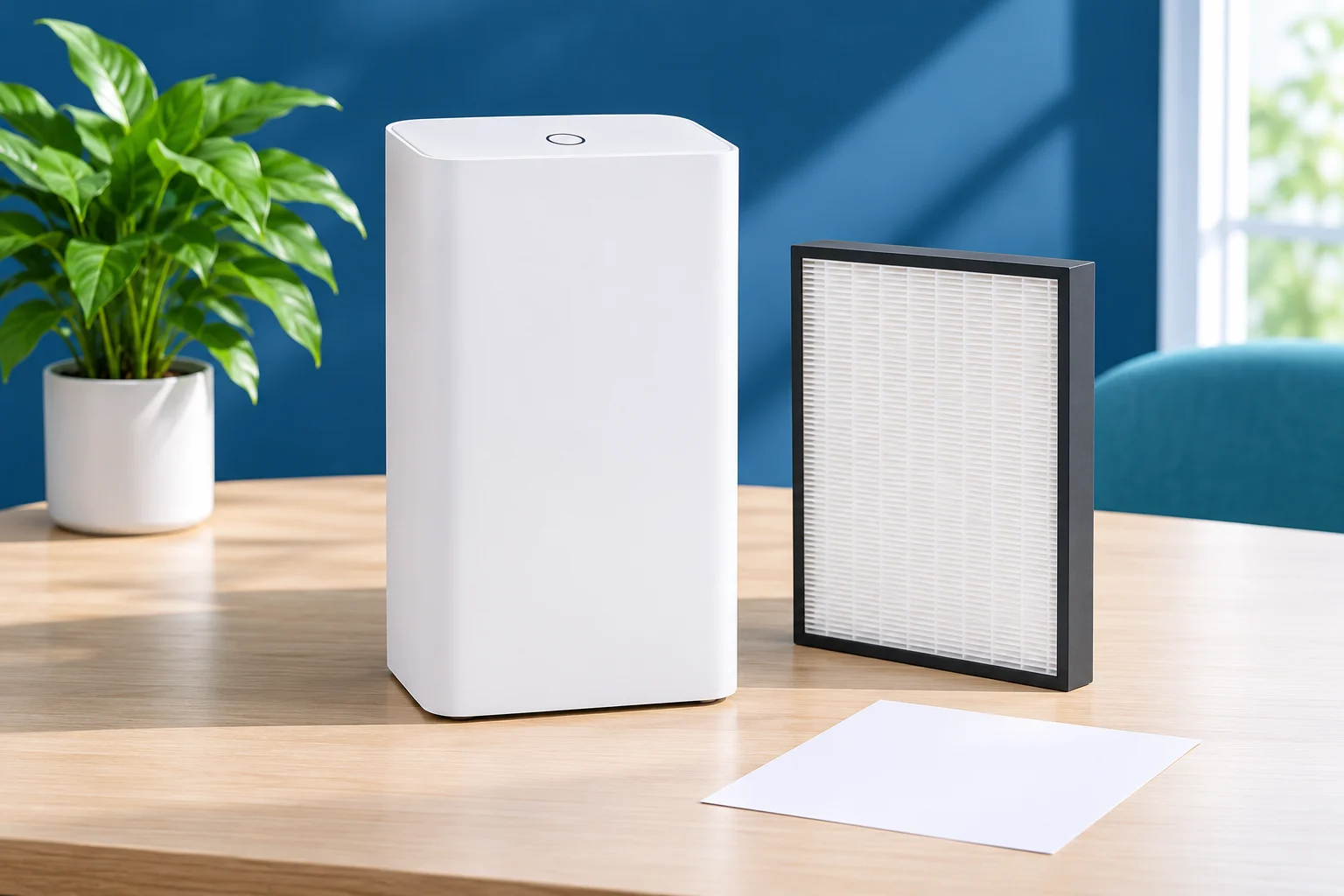
Air purifier wholesale from China can look attractive until you compare what each quote actually covers. One supplier may price an unbranded unit at its highest fan speed. Another may include custom packaging but quote a different filter and an untested room-coverage claim. Neither figure tells you enough to place an order.
Start with the room and the buyer’s market. The US Environmental Protection Agency (EPA) pairs a 200-square-foot room with a minimum clean air delivery rate (CADR) of 130 cubic feet per minute (cfm), assuming an eight-foot ceiling. That is sizing guidance, not a test result for any particular product. From there, use one specification to compare manufacturers, reports, minimum order quantities (MOQs), replacement filters and total costs.
If this is your first appliance order, use four terms consistently: CADR is the complete purifier’s particle-cleaning rate; MOQ is the supplier’s minimum order for a stated configuration; OEM means producing to a buyer’s specification; and ODM usually means adapting a supplier’s existing design. Ask each supplier what its OEM or ODM offer actually includes, since the labels alone do not define tooling or ownership.
What should you specify for air purifier wholesale from China?
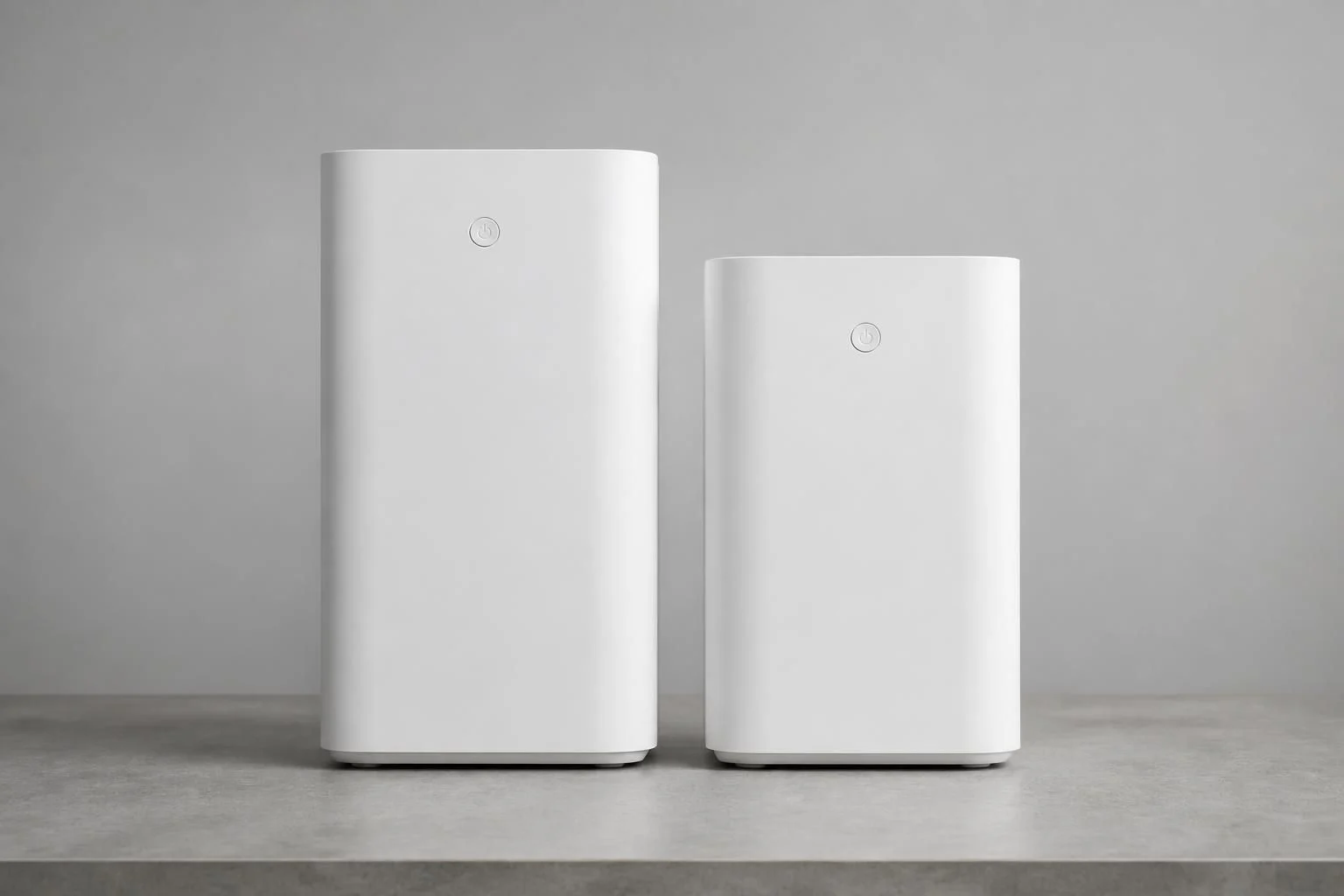
Review our air purifier product range and write a product brief before requesting prices. EPA’s 200-square-foot/130-cfm example gives buyers a starting point for particle-cleaning capacity, with an eight-foot ceiling assumed. Your brief should also name the destination market, electrical setup, target operating mode, filter arrangement and customization. Otherwise, suppliers may quote products that solve different problems.
Begin with the intended room. Record floor area and ceiling height. Decide whether the customer mainly wants particle reduction, odor treatment or both. CADR addresses particle removal; EPA says particle CADR does not measure gas removal. If odor treatment matters, ask for gas-specific evidence and details of the activated-carbon filter. Do not infer gas performance from a “HEPA” label.
Next, state the sales market and use case. A purifier for a US bedroom, a European office and a California retail listing can have different labeling and documentation needs. Set the voltage, frequency, plug, language, controls and any wireless features. If you need a quiet nighttime mode, define the acceptable noise and CADR in that same mode. A high-speed CADR beside a low-speed noise figure is an incomplete comparison.
Use this short RFQ as the starting point:
| Field | Specify or request |
|---|---|
| Destination and channel | Country or state; retail, hospitality or commercial use |
| Room and performance | Area, ceiling height, target particle CADR, units and test method |
| Operating modes | CADR, noise and power for each quoted speed |
| Exact product | Model, revision, filter SKU, dimensions and carton quantity |
| Electrical and controls | Voltage, plug, controls, app or radio features |
| Customization | Stock, logo, color, packaging, firmware or new tooling |
| Commercial terms | MOQ by option, sample cost, lead time, Incoterm and named place |
| After-sales | Replacement-filter MOQ, price, availability and warranty terms |
Related health appliances, such as humidifiers, dehumidifiers and air-quality monitors, need different performance tests. If your assortment includes them, request separate RFQs. The iHome home-appliance catalog can help define categories; it does not substitute for a model-specific specification.
How do you verify a China air purifier manufacturer?
A manufacturer’s listing is a starting lead, not proof that it makes the exact model you want. Verify the legal entity, factory address, production scope and contract counterparty. Then connect the quotation to a model-specific report, an approved sample and the production records. The EPA’s CADR guidance makes this model match important: a capacity figure is only useful when you know which complete device was tested.
Ask for the Chinese legal company name and business registration details. Check where assembly, filter production, testing and packing happen. Some operations may be subcontracted; the question is who performs them and who remains responsible. Confirm the name on the contract and payment beneficiary. If they differ, request a written explanation before sending funds.
For a claimed CADR or safety result, obtain the full report rather than a badge on a catalog page. Compare the manufacturer, model number, configuration, test standard, date, laboratory and report scope. Ask whether changes in fan, motor, filter media, enclosure or software require a new assessment. A report for a close-looking model does not automatically cover yours.
Finally, buy a sample with a recorded model and revision. Photograph the labels, filter, packaging and controls. Ask the supplier to identify the sample’s bill of materials (BOM) and document the permitted production substitutions. A factory tour or video call can establish that a facility exists, but it cannot independently prove a CADR claim.
You can source directly from a factory, through a trading company or with a sourcing agent. Each route changes who coordinates technical answers, samples and inspections. Choose by documented responsibility and access to evidence. For broader screening, see our guide to checking suppliers on Alibaba. iHome’s online sourcing service can help organize comparable quotations.
The strongest buying record links four things: the quoted model, the report, the approved sample and the final production lot. If one link changes, ask what else must be retested or reapproved. This chain is more useful than a folder of unrelated certificates.
Which CADR specifications make two quotes comparable?
Compare delivered clean air, not fan airflow or filter-media efficiency. EPA’s sizing table pairs a 300-square-foot room with at least 195 cfm CADR, assuming an eight-foot ceiling. Ask each supplier for the tested model, particle metric, units, test method and fan setting. Then obtain noise and power figures at that same setting.
CADR is reported for the complete purifier under a defined test. A fan’s airflow is not the same number: the filter and enclosure affect how much clean air the assembled product delivers. Likewise, a product’s “H13” filter label does not establish the purifier’s room coverage or rule out air bypass around the filter. Ask for the filter’s test basis and a separate whole-device CADR report.
Some reports distinguish smoke, dust and pollen CADR. Compare like with like. If one supplier quotes cfm and another uses cubic metres per hour (m³/h), convert units before ranking them: 1 cfm is approximately 1.699 m³/h. Thus 195 cfm is about 331 m³/h. Rounding does not fix a difference in test methods or operating modes.
| Room area | EPA minimum CADR |
|---|---|
| 100 sq ft | 65 cfm |
| 200 sq ft | 130 cfm |
| 300 sq ft | 195 cfm |
| 400 sq ft | 260 cfm |
| 500 sq ft | 325 cfm |
| 600 sq ft | 390 cfm |
Source: EPA, Guide to Air Cleaners in the Home. These are one set of room-sizing estimates for an eight-foot ceiling, not six independent product tests. Higher ceilings or unusual conditions may call for greater capacity.
The quote sheet should have one row per relevant speed: CADR, noise and watts. As a hypothetical example, imagine a unit advertised at 300 cfm and 25 dB. Can it produce both at once? Ask for the data at each mode. Also request an explanation of how the supplier calculated its advertised room coverage. EPA notes that CADR is typically measured at the highest speed; customers may use a quieter setting.
For gas or odor claims, request a separate test stating the target pollutant, concentration, duration and filter condition. EPA cautions that particle CADR does not rate gas removal. A carbon-colored layer is not enough evidence to promise odor performance.
What does MOQ mean for stock, OEM and ODM air purifiers?
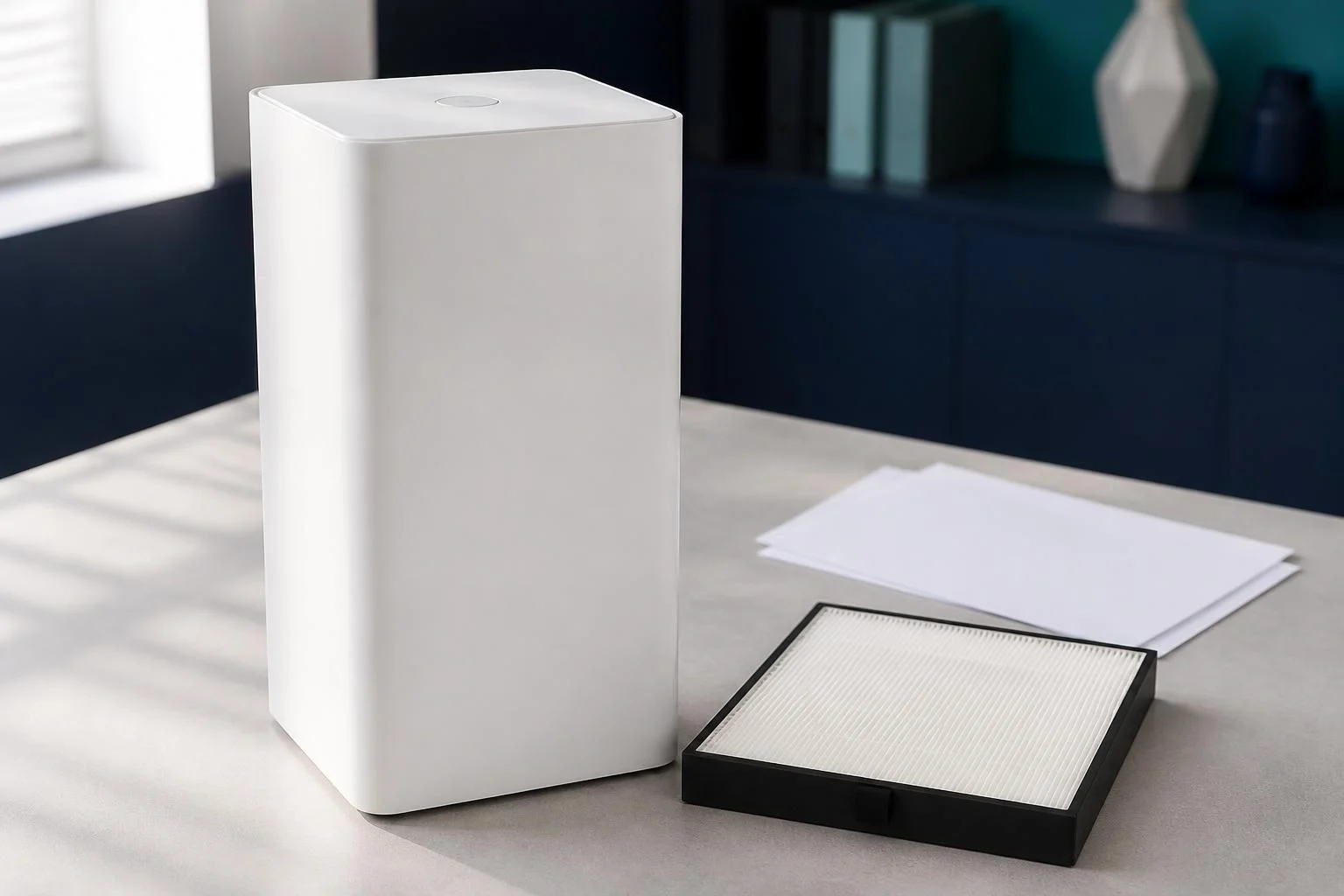
There is no reliable universal MOQ for Chinese air purifiers. The minimum depends on the exact model, supplier, available stock and requested changes. Ask for written minimums for four scopes: unchanged stock, logo printing, custom packaging and engineering or tooling changes. Keep replacement-filter MOQ in the same conversation, since the unit and its consumables must remain commercially viable.
“Private label” can mean a logo on a stock housing, a new carton, a changed control panel or a new design. These are different production jobs. Ask if the minimum applies per model, per color, per plug type or across a mixed order. Check carton multiples, deposit, sample cost, artwork charges and tooling ownership. Also ask whether a later reorder has a different minimum.
To make replies comparable, send the same requested quantity tiers to every candidate. 100, 500 and 1,000 units are example RFQ tiers, not observed market MOQs. Leave the minimum and price fields blank until a supplier replies:
| Quote scope | Your requested tier | Supplier’s confirmed MOQ | Unit price | Setup/tooling | Lead time |
|---|---|---|---|---|---|
| Stock model, no branding | 100 / 500 / 1,000 | — | — | — | — |
| Logo on existing housing | 100 / 500 / 1,000 | — | — | — | — |
| Custom retail carton/manual | 100 / 500 / 1,000 | — | — | — | — |
| Modified electronics or tooling | Project quote | — | — | — | — |
| Replacement filters | First order and reorder | — | — | — | — |
What if the lowest unit price requires a large custom-carton run, while the filters have a separate minimum? Calculate the cash tied up in both. Ask whether unused branded materials can be stored, returned or transferred, and who owns them. Treat verbal promises about “flexible MOQ” as unconfirmed until the quotation lists the exact scope and quantities.
Which documents must match the exact model and destination?
Document checks depend on where and how you will sell the purifier. Consult our guide to product certificates by market when preparing your destination-specific checklist. For California, check the exact model against the California Air Resources Board (CARB) certified-device list. CARB’s published guidance says certification does not demonstrate pollutant-removal effectiveness. Keep performance, electrical safety, emissions, energy claims and market permissions as separate questions.
For a US order, establish the applicable electrical and channel requirements for the precise product. Wireless or electronic features may add radio or emissions obligations. California-bound units need a current model-specific CARB check. If an energy-efficiency claim or label will be used, obtain the evidence for that program and model. Ask your importer or compliance adviser to review the planned sales channels before the purchase order.
For an EU order, identify the directives and regulations that apply to the configured device, including electrical, electromagnetic, radio and environmental obligations as relevant. The EU’s Your Europe CE-marking guidance says the manufacturer is responsible for meeting applicable requirements and preparing technical documentation and an EU declaration of conformity. Request those records for the actual model. A generic “CE certificate” picture does not answer which requirements were assessed or who takes responsibility.
Check claims in manuals, cartons and online listings too. “Removes viruses,” “medical grade” and “covers 1,000 square feet” need suitable evidence and may change the review. Avoid writing broad claims based only on a filter label. Where a supplier offers several plug, motor or connectivity variants, confirm which configurations the report covers.
How should samples, filters and production be approved?
Approve a reference sample against a signed specification before authorizing production. EPA’s guidance ties CADR to a complete purifier and its operating speed, so a quick visual inspection cannot independently verify the published rate. It can, however, catch the wrong filter, loose seals, inaccurate labels, control failures and packaging differences before those become a larger shipment problem.
Record the sample’s model, revision, filter SKU, serial or lot identification, firmware version if relevant, plug and packaging artwork. Test the functions a buyer can reasonably observe: speed controls, indicators, filter seating, abnormal vibration and noise, power draw and manual accuracy. If a CADR claim is commercially important, commission appropriate independent testing instead of treating a handheld particle reading as equivalent.
Agree in writing which components may change and who approves a replacement. A motor or filter change can affect performance, power, noise and the scope of reports. Set inspection criteria, defect categories and the sampling method before production. A pre-shipment check should compare units with the approved sample and documents; it is not a blanket guarantee of every unit’s performance.
Make the replacement-filter plan part of sample approval. Verify fit, labels, packaging, separate MOQ, reorder lead time and how long the supplier expects to offer the SKU. A purifier without a dependable compatible filter can create returns and service problems even when the first shipment passes inspection.
How do you compare total quotes and place the order?
Compare offers using the same model specification and delivery basis. The unit price is only one component: add tooling allocation, required tests, inspection, freight, insurance, destination handling and applicable duties or nonrecoverable taxes. Divide by units you expect to sell. State your assumptions, including rejects and whether tax is recoverable, before calling one offer cheaper.
Here is a hypothetical comparison that shows why scope matters. Quote A offers 500 unbranded units at $40 each, with $3,000 freight and $1,000 testing and inspection: $24,000 total, or $48 per unit before destination taxes. Quote B offers the same 500-unit model at $38 each, but adds $2,000 packaging setup, $3,000 freight and $1,000 testing and inspection: $25,000 total, or $50 per unit. These numbers are arithmetic examples, not supplier quotes or market benchmarks. If B includes a different filter or delivery term, even this comparison is incomplete.
Request each supplier’s Incoterm, named place and version, plus carton dimensions and gross weight. Freight costs can change the ranking of compact versus bulky models. The iHome logistics and warehouse service can help plan delivery; the buyer still needs to confirm importer identity, customs documents and destination obligations.
Before releasing the production deposit, confirm seven items: legal entity and payment beneficiary; exact model and report scope; approved sample and change control; written MOQ and customization charges; filter replenishment; destination review; and payment, delivery and inspection milestones. If one item is unresolved, state who owns it and when it must be closed.
For a useful first response, send the destination, target CADR, first-order and annual quantities, branding scope, plug type, filter needs and delivery date. Get a Free Quote based on that specification.
Frequently asked questions
What is the MOQ for private-label air purifiers?
There is no verified universal number. Ask each supplier for separate minimums for a stock unit, printed logo, custom carton and any tooling or electronics change. If you request 100, 500 and 1,000 units, label them as your quote tiers, not industry benchmarks. Confirm whether the MOQ is per model, color, plug and replacement-filter SKU.
Does an H13 filter prove the stated CADR?
No. An “H13” label on a filter does not give the clean-air delivery rate of the assembled purifier. CADR measures the complete device in a defined operating mode. The EPA guide pairs 200 square feet with at least 130 cfm for its eight-foot-ceiling example; request a whole-device report before applying that guidance to a quoted model.
How do I convert CADR from cfm to m³/h?
Multiply cfm by approximately 1.699. For example, 130 cfm is about 221 m³/h after rounding. This conversion changes units, not the underlying test quality. Ask whether both figures refer to the same model, particle metric and fan mode. EPA’s 130-cfm example applies to a 200-square-foot room with an eight-foot ceiling.
Does CARB certification prove an air purifier works well?
No. CARB’s certified-device list says certification does not establish air-cleaning effectiveness or general health safety. Check the exact model against CARB’s current list before a California sale, then assess CADR and other performance evidence separately. A listing is a regulatory check, not a substitute for a performance report.
Your next purchasing step
Send a common RFQ to several qualified suppliers, then compare only like-for-like responses. Keep the model, CADR mode, destination, filter SKU, customization scope and delivery term visible in one worksheet. Approve a traceable sample and model-specific evidence before production. Share your product brief with iHome’s sourcing team if you want help collecting and checking offers.

Gong Zheng is a blog editor for iHome, focusing on global sourcing, wholesale market trends, and practical advice for international buyers. Drawing on extensive experience in digital marketing and cross-border trade, he shares expert insights to help small and medium-sized enterprises source products more efficiently and avoid common pitfalls. Passionate about connecting buyers with reliable suppliers, he writes in a clear, approachable style that makes complex topics easy to understand.