








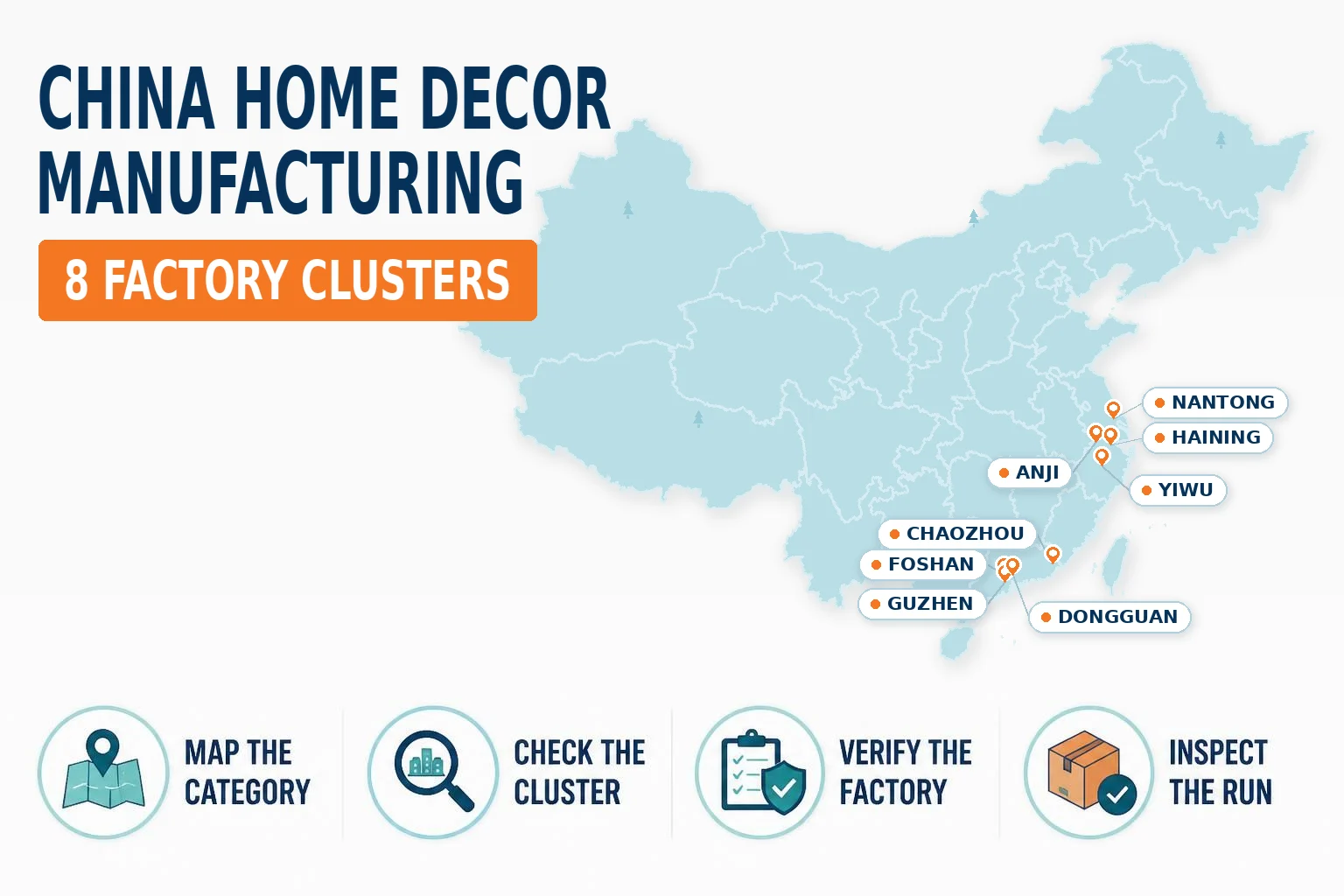
China does not have one “home decor city.” Its supply chain is divided among specialized production clusters, each with its own materials, supplier base, buying practices, and quality risks.
That distinction matters. Foshan is a practical starting point for a mixed furniture project. Guzhen is more focused on lighting. Nantong is built around finished home textiles. Yiwu works well for small, testable assortments, although a seller there may be a trader rather than the factory that made the product.
This guide maps eight practical sourcing clusters by category. It also shows what each place is best at, where it falls short, and how to verify that a supplier’s advertised location matches its real production capability.
Key Takeaways
- Foshan is the broadest multi-category home-furnishing hub in this map.
- Guzhen specializes in lighting; Anji in bamboo and chairs; Nantong in finished home textiles.
- Yiwu is strong for SKU discovery and small decor, but not proof of factory ownership.
- The safest shortlist starts with the right cluster, then verifies the actual production site.
If you are still planning the buying process, review our online sourcing service to see how product selection and supplier communication can be coordinated.
Eight production clusters by category
1. Why Foshan is the broadest home decor cluster
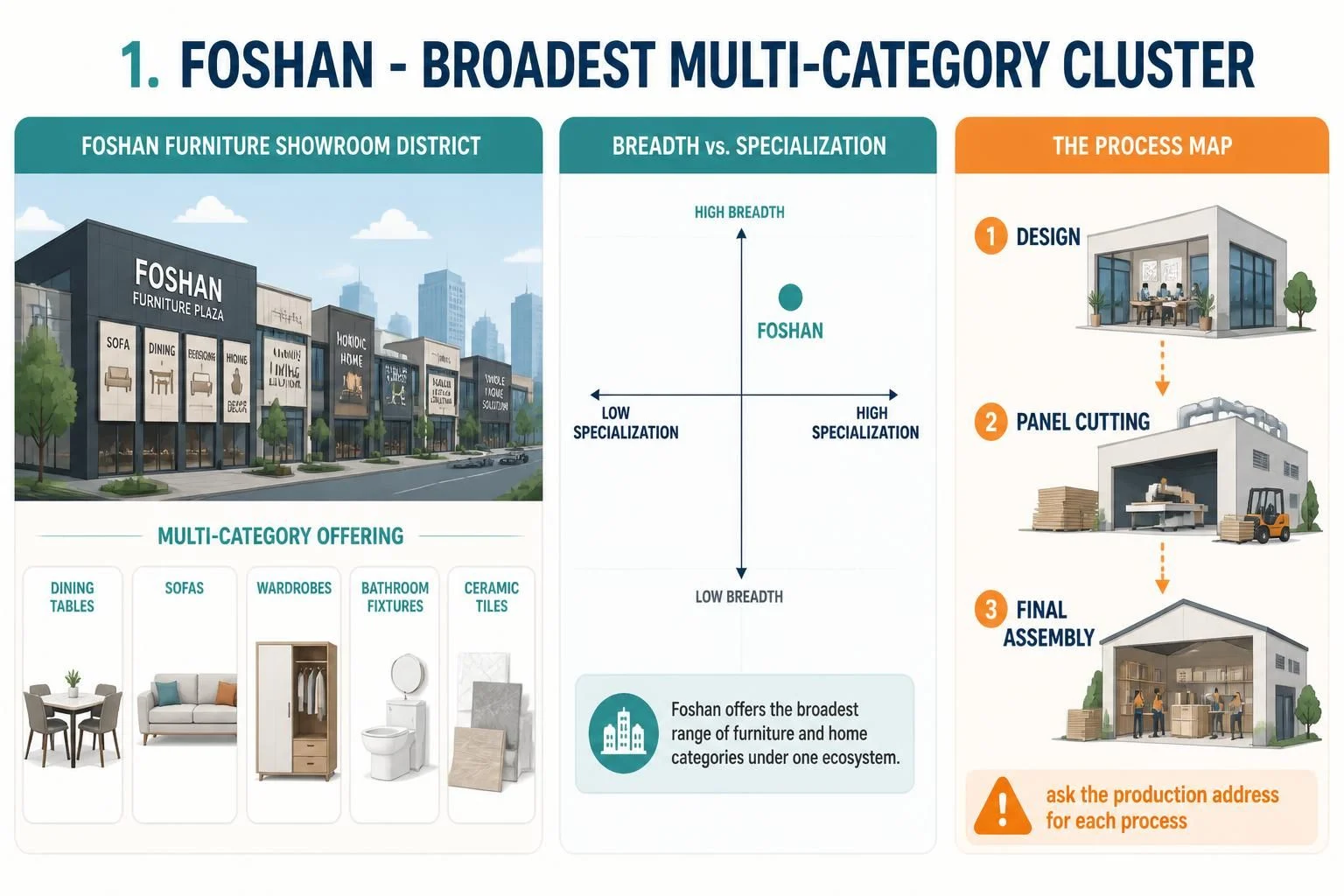
Foshan is the best first stop when your project spans several categories. The China National Furniture Association lists Longjiang as a comprehensive furniture production area and Lecong as a furniture trade base. The same directory also identifies nearby export and furniture clusters across Guangdong. In practice, that gives buyers access to furniture, cabinetry, upholstery, sanitary ware, building ceramics, hardware, and dense showroom networks within one regional system.
The Foshan ecosystem is useful for hospitality projects, apartment packages, and retailers that need several related categories. A buyer can compare dining tables, bedroom furniture, sofas, wardrobes, bathroom products, and tile finishes without rebuilding the supplier list from scratch. For a mixed shipment, review the requirements for logistics and freight before confirming the supplier list.
The trade-off is breadth. A showroom district can make a supplier look more vertically integrated than it is. One company may design the product, another may cut the panels, and a third may handle the final assembly. Ask for the production address for each major process.
Foshan is also a major ceramics center. China had 938 building-ceramic production enterprises and 2,193 production lines at the end of 2024, according to CeramBath’s industry overview (CeramBath, 2025). That figure covers building ceramics, not every decorative ceramic item, so it should not be used as a proxy for porcelain giftware.
Foshan fits furniture packages, cabinetry, sofas, sanitary ware, architectural ceramics, and mixed-category buying. Buyers seeking one narrow craft specialty or a small quantity of handmade porcelain may find a specialist cluster more efficient.
| Cluster | Breadth | Specialization | Best buying model |
|---|---|---|---|
| Foshan | High | Medium | Multi-category projects |
| Guzhen | Medium | High | Lighting programs |
| Anji | Low to medium | High | Chair and bamboo specialists |
| Yiwu | Very high | Low to medium | Small mixed assortments |
2. Why Guzhen is the specialist lighting base
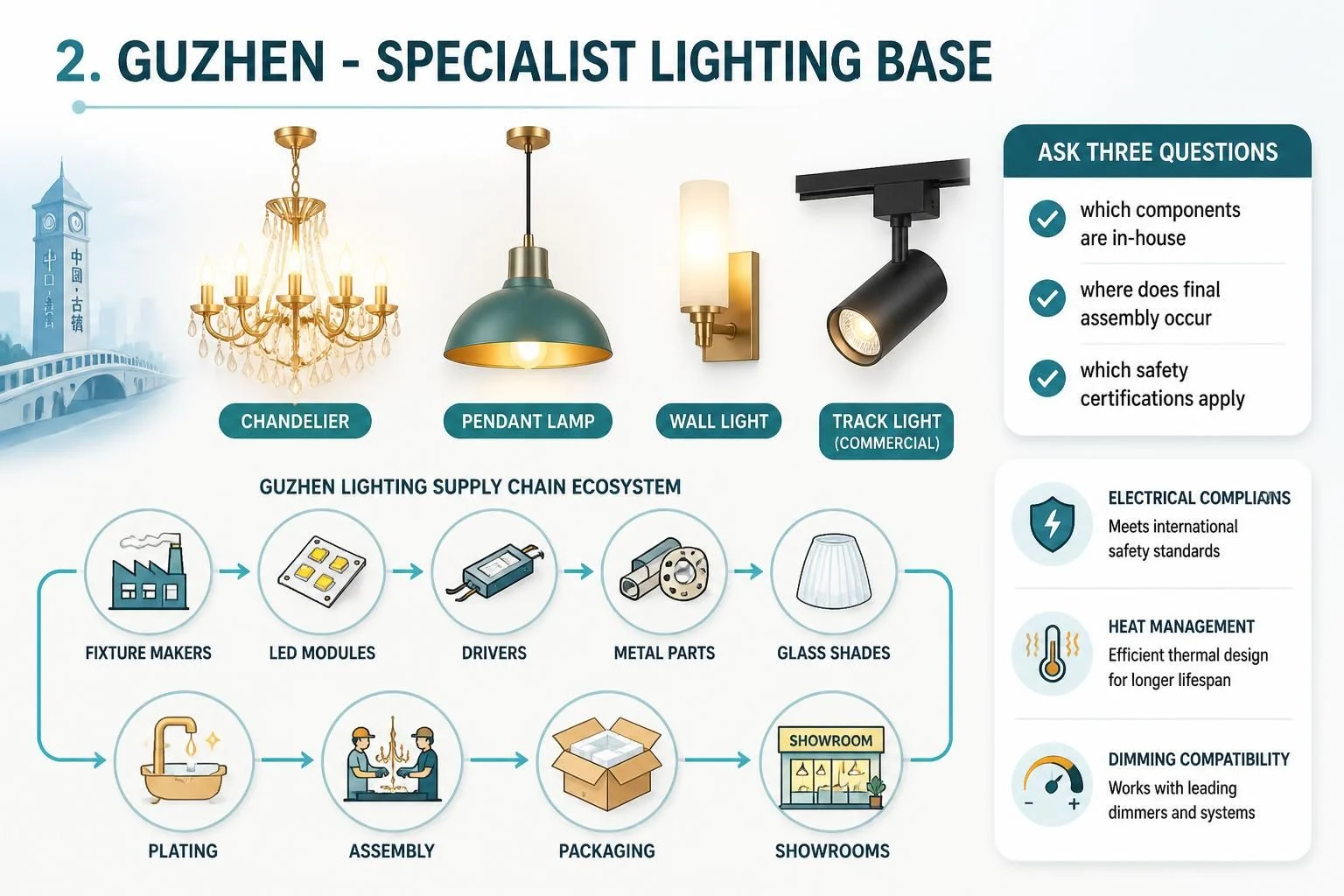
Guzhen, in Zhongshan, is the clearest specialist cluster for decorative and architectural lighting. Official local-government materials describe Guzhen as the center of Zhongshan’s lighting industry. Because the most widely cited output figures are older, treat them as historical context rather than a current market forecast.
Guzhen is valuable because the ecosystem extends beyond finished lamps. Buyers can find fixture makers, LED modules, drivers, metal parts, glass shades, plating, assembly services, packaging, and lighting showrooms in the same regional network.
That density helps with customization. You can change a pendant’s finish, adjust a chandelier’s arm count, specify a different driver, or create a coordinated hospitality collection. It also creates a verification problem: a polished showroom does not prove that the seller owns the assembly line.
Ask three separate questions: Which components are made in-house? Where does final assembly occur? Which safety certifications apply to the destination market? Electrical compliance, heat management, dimming compatibility, and packaging deserve more attention than a product photo.
Guzhen fits chandeliers, pendants, wall lights, decorative fixtures, commercial lighting, and custom lighting programs. It is a poor fit for general home-goods buying or untested plug-and-play electrical products.
3. Why Dongguan fits export-oriented upholstery and OEM
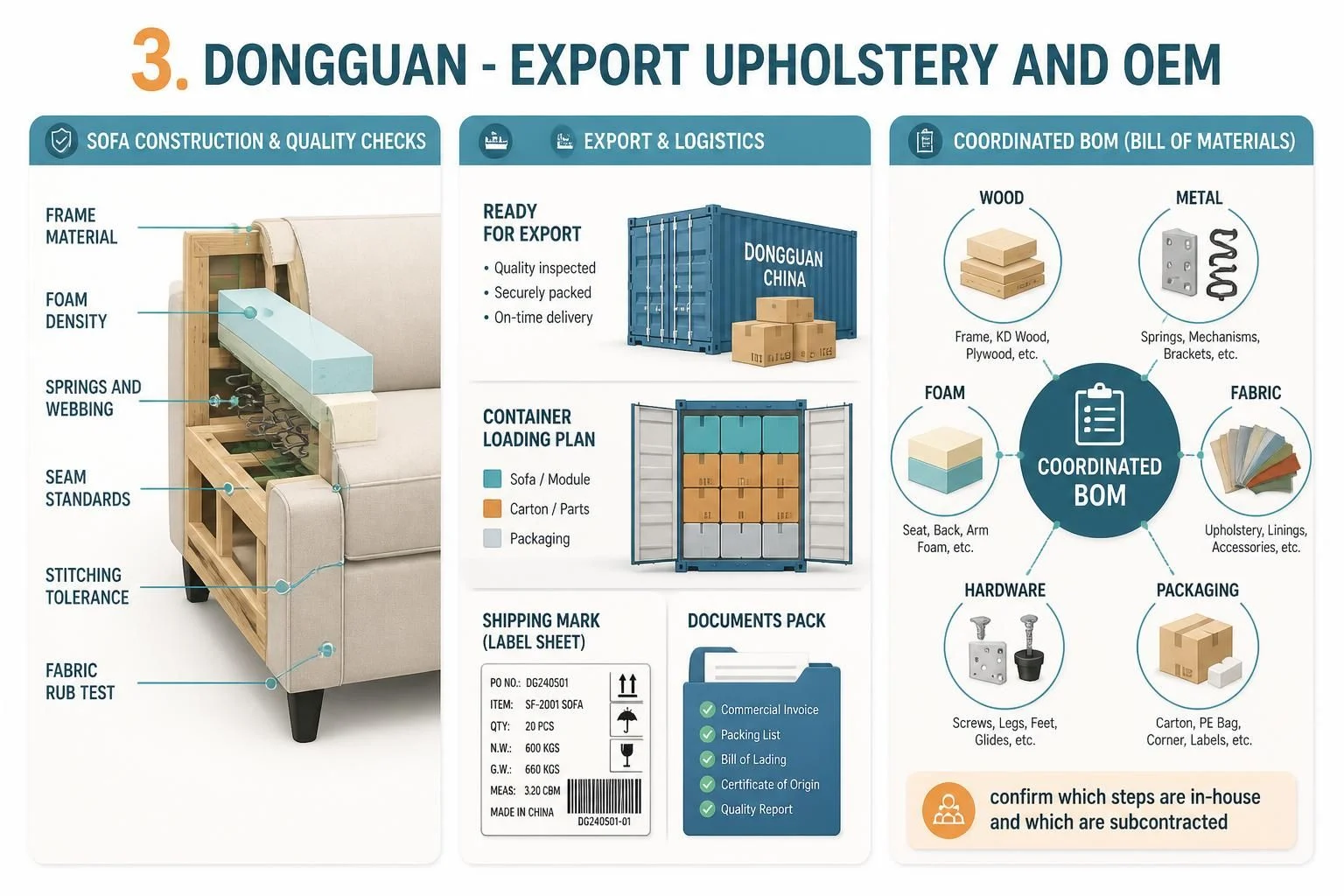
Dongguan is a strong choice when upholstery, component coordination, and export execution matter more than showroom breadth. The China National Furniture Association lists Dalingshan as an export base and Houjie as a furniture trade base. That makes the area especially relevant for sofas, upholstered beds, mattresses, furniture components, and OEM programs built for overseas retail.
The main advantage is process discipline. Export-oriented suppliers are more likely to understand carton dimensions, container loading, labeling, replacement parts, and the paperwork required by overseas buyers. That does not eliminate quality risk, but it can reduce avoidable friction after production.
For upholstered products, inspect the hidden work. Ask for the frame material, foam density, webbing or spring construction, seam standards, stitching tolerance, and fabric rub-test data. A sofa can look identical in a showroom while performing very differently after six months of use.
Dongguan is also useful when you need a coordinated bill of materials. A supplier may be able to combine wood, metal, foam, fabric, hardware, and packaging through a stable local network. The buyer still needs to confirm which steps are controlled directly and which are subcontracted.
Dongguan fits upholstered furniture, export OEM, private label, component-rich products, and hospitality seating. One-off artisan pieces and broad assortments across unrelated categories may be easier to source elsewhere.
4. Why Anji is worth checking for bamboo and chairs
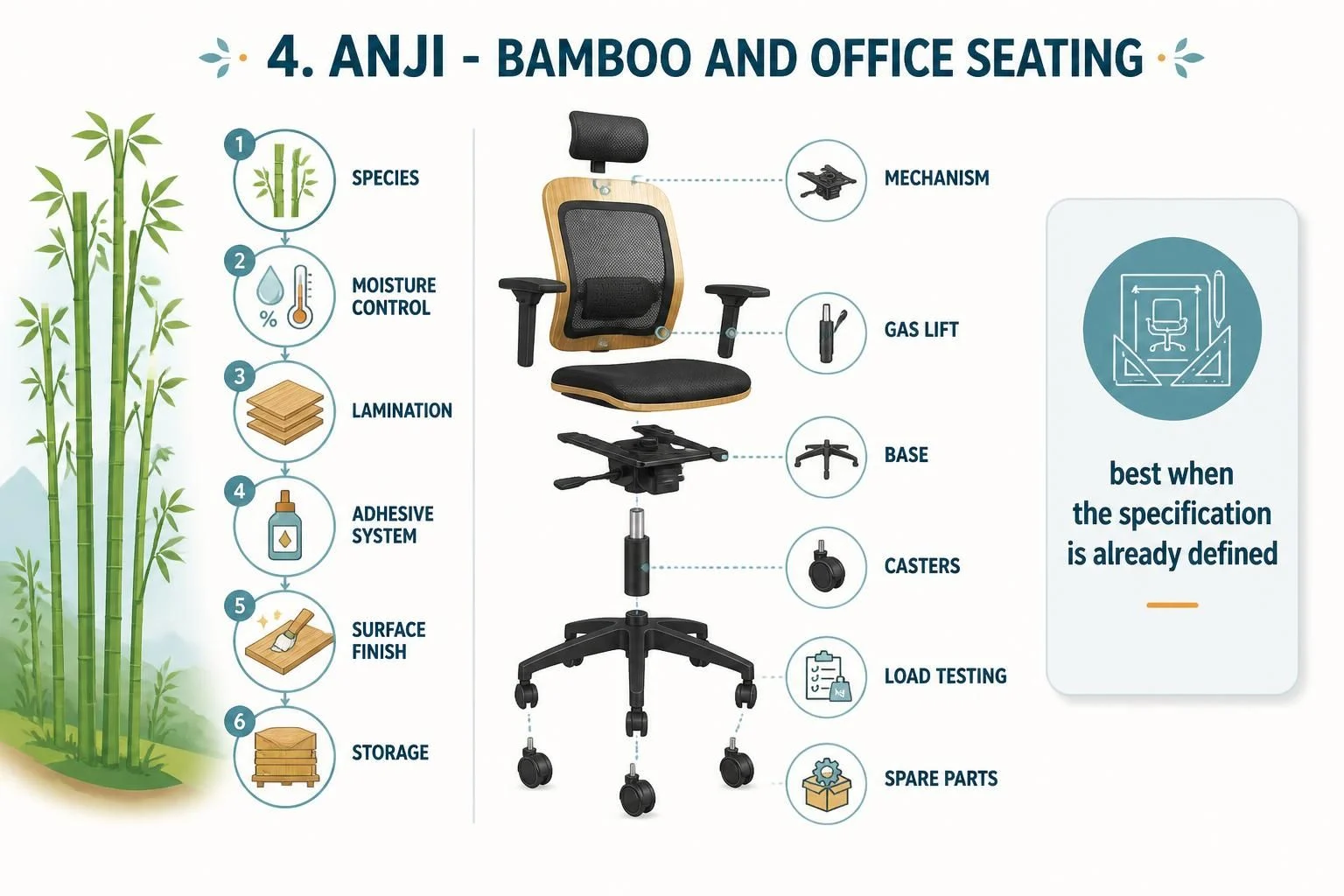
Anji, Zhejiang, is a specialist cluster for bamboo products and office seating. The China National Furniture Association identifies Anji as a furniture export base (China National Furniture Association, accessed 2026). Its value is concentration: when your product depends on bamboo processing, chair components, ergonomic construction, or repeatable seating production, a specialist network can be more useful than a general furniture market.
Bamboo sourcing requires more than a visual match. Ask about species, moisture control, lamination, adhesive systems, surface finishing, and storage. For chairs, review the mechanism, gas lift, base, casters, load testing, and replacement-parts policy.
The cluster is a good fit for buyers who already know the product specification. It is less useful for someone still browsing across ten unrelated categories. A clear technical drawing and sample approval process will save more time than a long supplier list.
Anji fits bamboo furniture, office chairs, ergonomic seating, and repeatable chair programs. It is less useful for broad decor shopping, small seasonal assortments, or products without a defined material specification.
5. Why Haining matters when fabric is the product
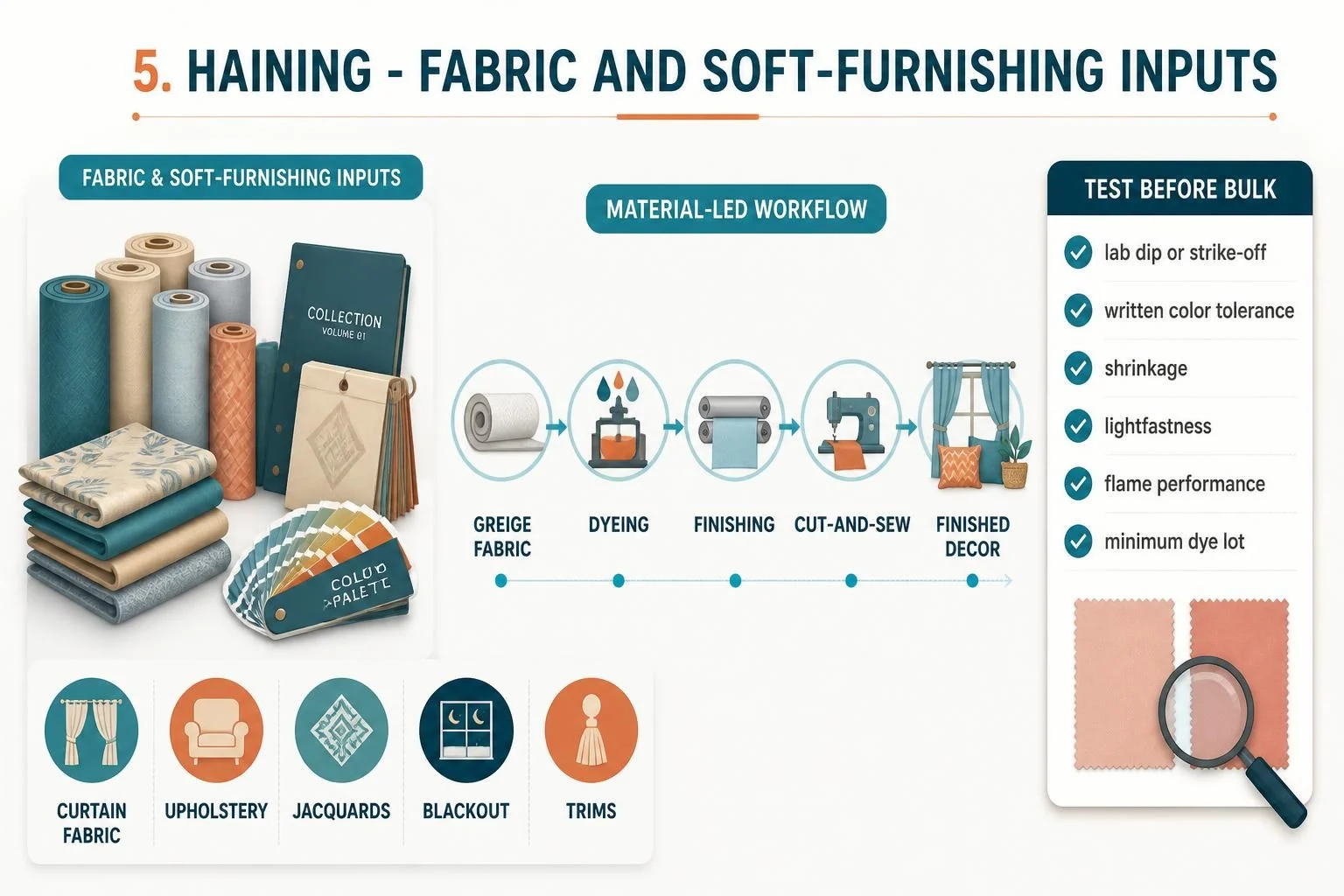
Haining is more useful for material-led sourcing than for finished decor. The China National Furniture Association lists Haining as a furniture export base. In practical terms, buyers investigate the area for curtain fabrics, upholstery materials, jacquards, blackout textiles, trims, and related soft-furnishing inputs.
The buying decision changes when fabric carries most of the product value. Color consistency, repeat alignment, hand feel, shrinkage, lightfastness, flame performance, and minimum dye lots become central. A supplier that can produce a beautiful sample may still struggle to reproduce the same shade at scale.
Request a lab dip or strike-off before bulk approval. Define the acceptable color tolerance in writing. For curtains and upholstery, test the actual finished construction rather than approving fabric alone.
Haining fits curtain and upholstery fabric, jacquards, blackout materials, trims, and other soft-furnishing inputs. Buyers who want a finished product with little material development may prefer a finished-goods cluster.
6. Why Nantong is a finished home-textile hub
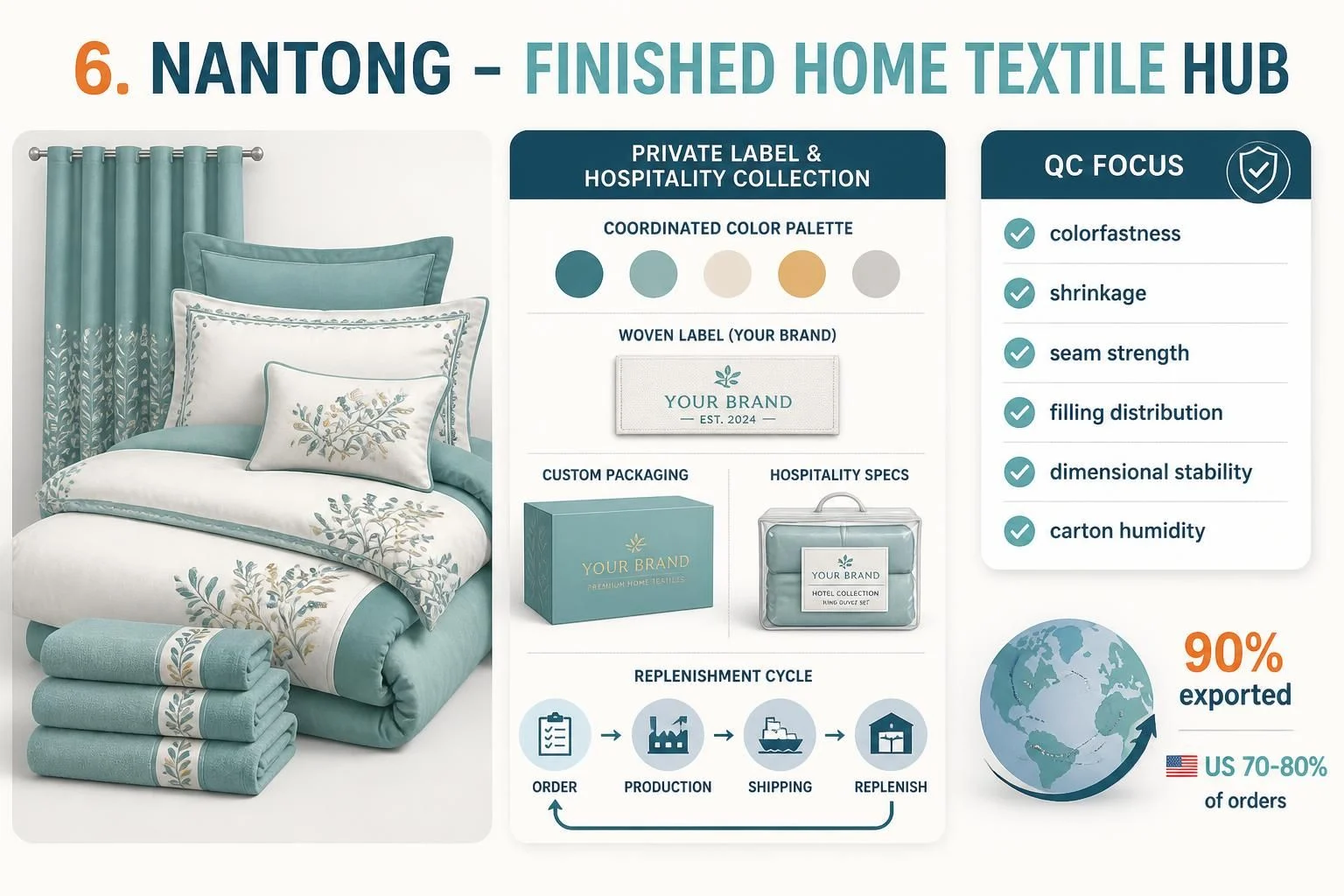
Nantong’s Tongzhou district is built around finished home textiles, bedding, towels, curtains, and coordinated household collections. A Nantong government report describes Nantong Home Textile City as a major production base and trading center, while another 2025 report notes that a local exporter sends 90% of its business overseas, with the United States accounting for 70% to 80% of its orders (Nantong municipal government, 2025).
That export orientation matters for private label and hospitality buyers. The cluster can support coordinated bedding programs, embroidery, packaging, labeling, and replenishment. It is especially useful when several products must share the same color palette, fabric story, or seasonal collection.
Quality control should focus on colorfastness, shrinkage, seam strength, filling distribution, dimensional stability, and carton humidity. A finished textile order can fail through small inconsistencies repeated across thousands of units.
Nantong fits bedding, towels, hotel textiles, curtains, embroidery, and private label collections. It is less suitable for hard decor, single handmade pieces, or small orders with no repeat-production requirement.
7. Why Jingdezhen and Chaozhou serve different ceramic buyers
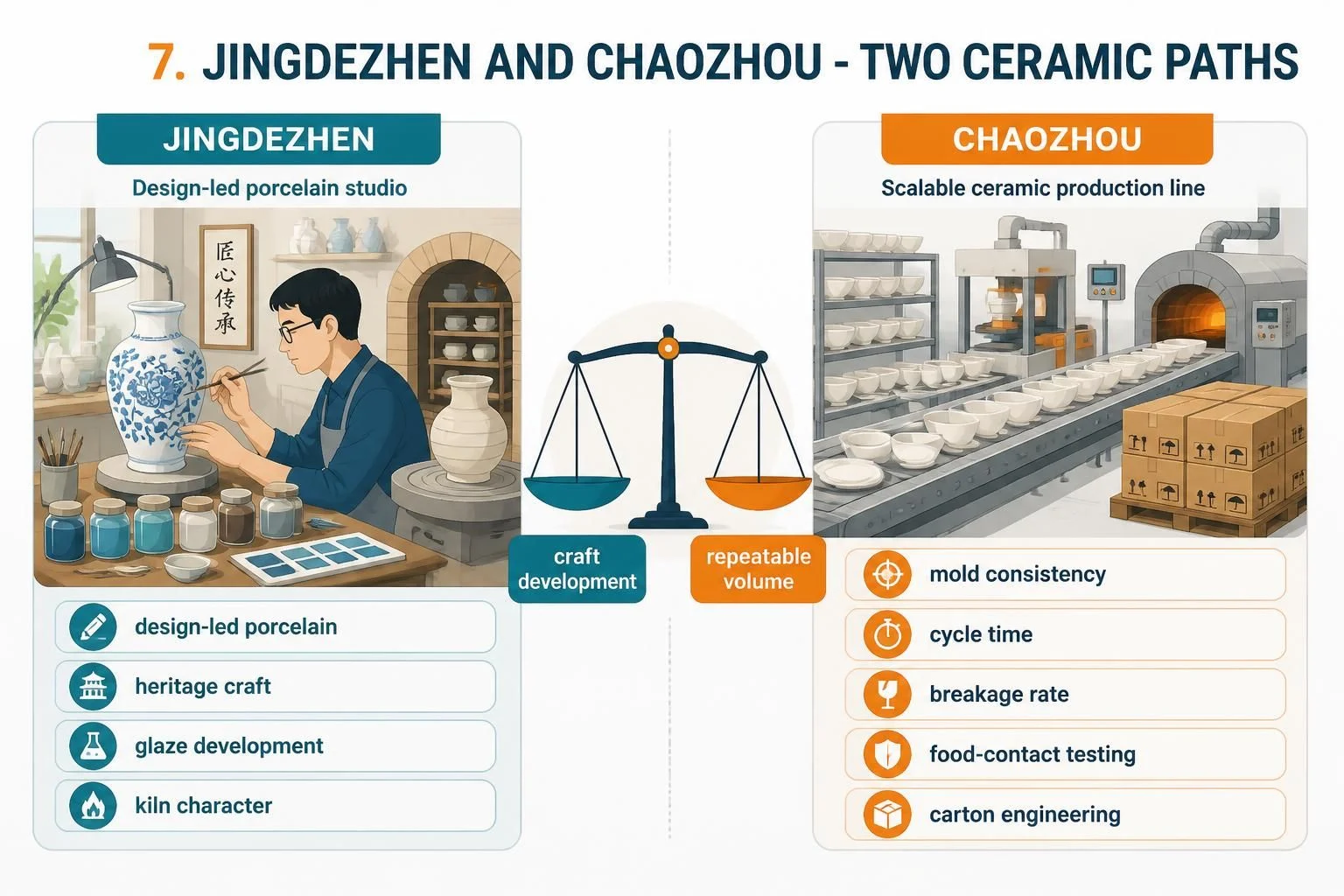
Jingdezhen and Chaozhou should not be treated as interchangeable ceramic destinations. Jingdezhen is associated with design-led porcelain, heritage craft, and higher-touch development. Chaozhou is more relevant when the buyer needs scalable ceramic gifts, tabletop items, sanitary ceramics, or repeatable decorative production.
The distinction is practical. A design studio may care most about glaze development, shape refinement, hand finishing, and kiln character. A retail program may care more about mold consistency, cycle time, breakage rates, food-contact testing, and carton engineering.
China’s 2024 building-ceramic data shows the scale of the wider ceramics industry: 938 production enterprises and 2,193 production lines remained at year-end (CeramBath, 2025). Building ceramics are only one segment, so buyers should ask which kiln, material, and finishing process actually matches the product they want.
For any ceramic order, test glaze variation across a production run. Approve the inner packaging, not only the master carton. For tableware, confirm the destination market’s food-contact requirements before the first bulk order.
Jingdezhen and Chaozhou fit porcelain gifts, tabletop products, decorative ceramics, design-led collections, and scalable ceramic programs. Buyers with a few unrelated SKUs and no repeat-order plan may be better served by a wholesale market.
8. Why Yiwu is best for small decor and SKU testing
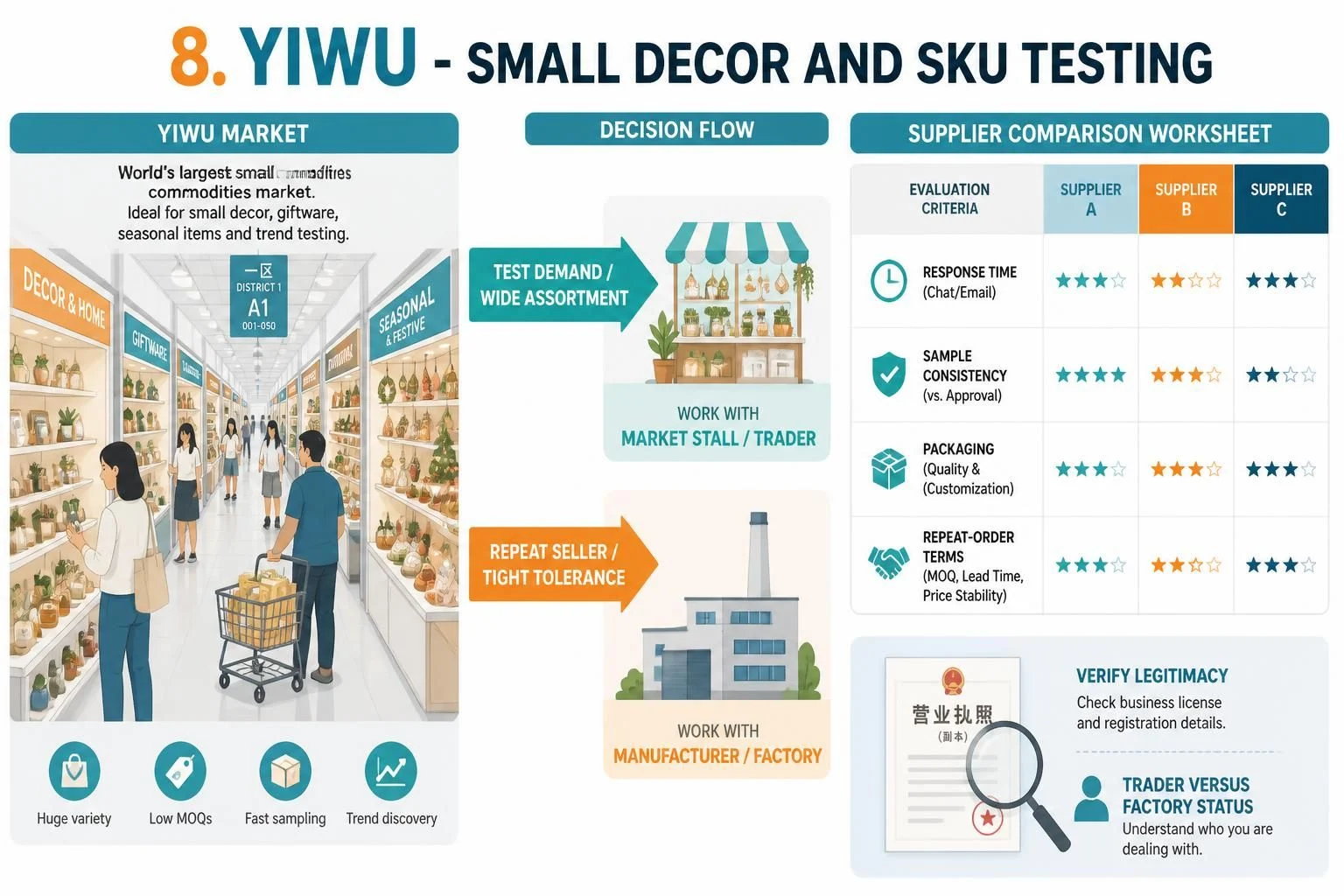
Yiwu is the most efficient starting point for small decor, giftware, seasonal items, and mixed-SKU experiments. Its strength is assortment. Buyers can compare many products quickly, test price points, and build a small collection without committing to one factory’s full production schedule.
The catch is that Yiwu is a market and sourcing ecosystem, not proof that every seller owns a factory. A trader may consolidate products from several production towns. That can be useful for assortment building, but it changes how you manage quality, traceability, packaging, and replenishment.
Use Yiwu when you are testing demand or buying a wide assortment in modest quantities. Move to a specialist factory cluster when a product becomes a repeat seller, requires tighter tolerances, or needs meaningful customization.
Yiwu fits small decor, giftware, seasonal goods, mixed cartons, trend testing, and low-to-mid-ticket products. It is less suitable for products that need deep engineering, strict traceability, or one factory to control every process.
For a serious shortlist, compare at least three suppliers on response time, sample consistency, packaging, and repeat-order terms. Record the results in the same worksheet so a polished sales presentation does not outweigh production evidence.
How do you choose the right China production cluster?
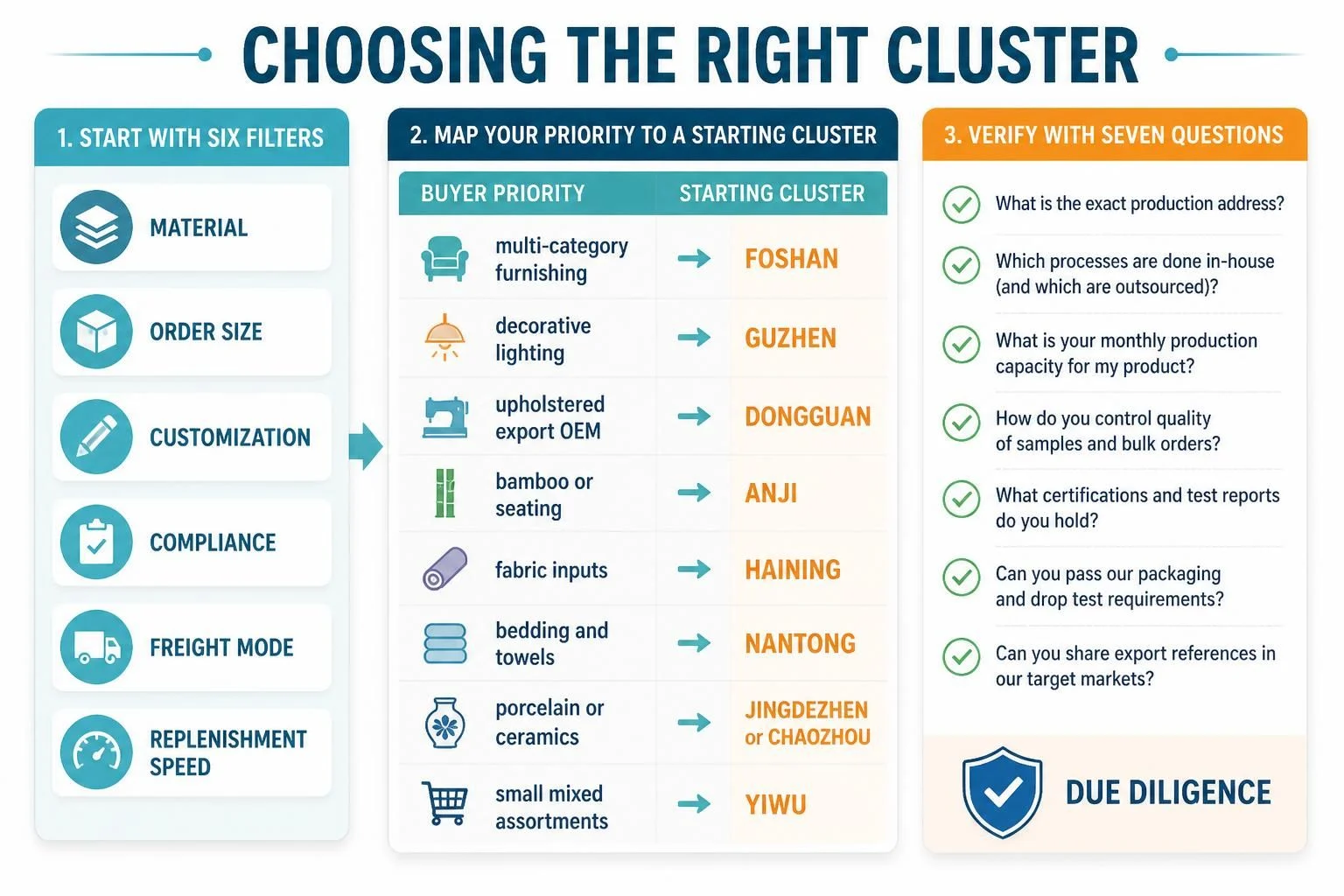
Start with the product’s main risk, not the city name. If the risk is coordination across many categories, start with Foshan. If it is electrical safety, start with Guzhen and build a compliance checklist. If it is shade consistency, start with Haining or Nantong and test the full finished construction. If it is breakage, test the kiln output and packaging together.
A practical shortlist can use six filters: material, order size, customization, compliance, freight mode, and replenishment speed. Then ask each supplier the same seven questions:
- What is the full production address?
- Which processes are in-house?
- What is the monthly capacity for this exact product?
- How are approved samples controlled during bulk production?
- Which certifications and test reports apply to the destination market?
- What packaging test has been completed?
- Which export references or inspection records can be shared?
A cluster narrows the search. It does not replace due diligence. Would you rather compare ten relevant factories or fifty general suppliers? The better shortlist usually comes from category fit first, then verification depth.
| If your priority is… | Start with… | Verify first… |
|---|---|---|
| Multi-category furnishing | Foshan | Subcontracting and consolidation |
| Decorative lighting | Guzhen | Electrical compliance and assembly |
| Upholstered export OEM | Dongguan | Frame, foam, fabric, and packaging |
| Bamboo or office seating | Anji | Material treatment and load testing |
| Fabric inputs | Haining | Color, shrinkage, and repeatability |
| Bedding and towels | Nantong | Colorfastness and dimensional stability |
| Porcelain or ceramics | Jingdezhen or Chaozhou | Glaze, kiln consistency, and breakage |
| Small mixed assortments | Yiwu | Trader versus factory status |
For supplier screening, compare the factory evidence with the guidance in is Alibaba safe to buy from before moving to a production order.
Frequently Asked Questions
Is Foshan the best place to source all home decor?
Foshan is the broadest starting point, not the universal answer. CNFA lists Longjiang as a comprehensive furniture production area and Lecong as a furniture trade base, while separate clusters specialize in lighting, textiles, chairs, ceramics, and small decor (CNFA, accessed 2026). Choose by category and risk.
Should I buy from Yiwu or a specialist factory cluster?
Use Yiwu for small mixed assortments, trend testing, and early SKU discovery. Use a specialist cluster when the product becomes a repeat seller or needs tighter tolerances. The key distinction is traceability: a Yiwu seller may consolidate goods from several factories, while a specialist supplier may control more of the production process.
Where are China’s lighting factories?
Start with Guzhen in Zhongshan. Local government materials identify Guzhen as the center of Zhongshan’s lighting industry. Because older output and export figures are often repeated without a current date, verify the supplier’s present capacity rather than relying on a historical headline number. Verify whether the supplier makes the fixture, assembles components, or trades finished goods.
What is the biggest sourcing mistake?
The common mistake is treating a showroom, market, or sales office as proof of factory ownership. For every shortlisted supplier, match the business license address with the production address, sample invoice, inspection location, and factory video. If those addresses differ, ask why before approving a bulk order.
How do I verify a cluster supplier?
Use a document-and-sample sequence. Confirm the legal entity, production address, process list, capacity, certifications, packaging test, and export references. Then inspect the approved sample against the first production run. For ceramics, lighting, upholstery, and textiles, the main risk is often process variation rather than the first sample itself.
Method note: The breadth and specialization labels in this article are editorial ratings based on cluster scope, supplier density, and typical buyer use cases. They are not official rankings.
Conclusion: source by category, then verify the factory
China’s home decor supply chain is easier to understand when you map it by production cluster. Foshan offers breadth. Guzhen offers lighting specialization. Dongguan supports upholstery and export OEM. Anji focuses on bamboo and chairs. Haining and Nantong support soft furnishings. Jingdezhen and Chaozhou serve different ceramic needs. Yiwu makes small assortment testing easier.
The right cluster reduces search time, but it does not make a supplier trustworthy by itself. Match the cluster to the product’s main risk, ask where each process happens, and inspect the production system behind the showroom.

Gong Zheng is a blog editor for iHome, focusing on global sourcing, wholesale market trends, and practical advice for international buyers. Drawing on extensive experience in digital marketing and cross-border trade, he shares expert insights to help small and medium-sized enterprises source products more efficiently and avoid common pitfalls. Passionate about connecting buyers with reliable suppliers, he writes in a clear, approachable style that makes complex topics easy to understand.