








Christmas inventory has one selling window. A container that arrives after your launch date is not a bargain; it is a markdown problem. For the 2027 season, plan backward from the date your stock must be available in your warehouse, store, or fulfillment center. Then lock the product specification, compliance file, production slot, inspection, and freight booking in that order.
The sections below cover the calendar, product categories, MOQ and lead-time estimates, supplier checks, compliance questions, landed-cost math, and purchase-order controls that seasonal buyers deal with in practice.
Key Takeaways
- In this example backward plan, supplier discovery starts in January or February 2027, with standard-product orders targeted for May or June.
- Illustrative planning ranges are not guarantees: samples may take 7–21 days, production 20–45 days, and ocean freight 25–45 days port-to-port, depending on the lane and quote date.
- Compare landed cost, not unit price. Confirm the destination market’s safety, labeling, tax, and importer-of-record requirements before paying a deposit.
When should you start sourcing Christmas products for 2027?
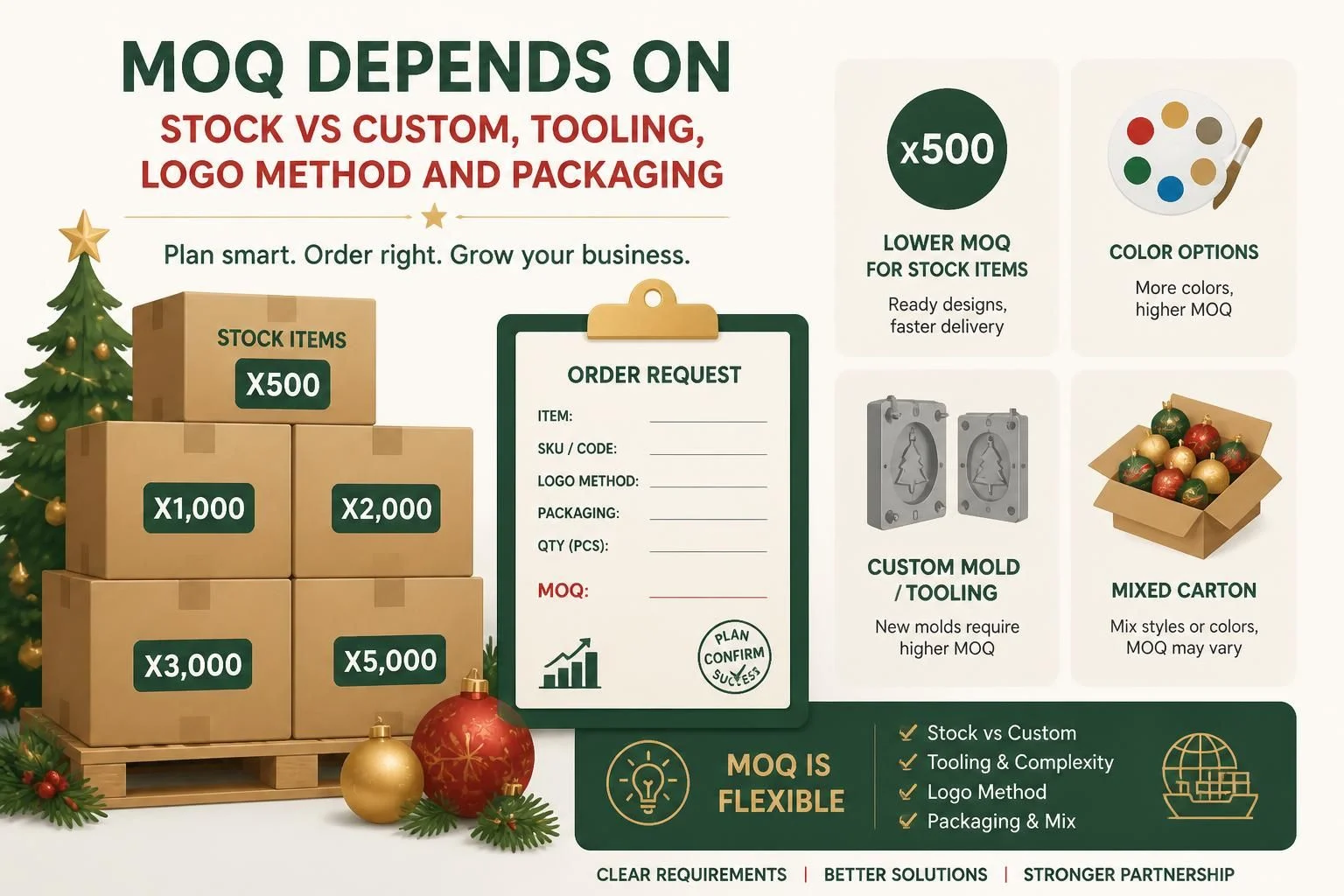
For standard Christmas products, an example backward plan begins discovery in January or February 2027, approves samples by March or April, and targets production orders by May or June. It leaves July or August for production and inspection, then targets September or October arrival. Treat these as planning assumptions; your country, product risk, launch date, and transport lane may move every milestone.
A backward calendar
| Milestone | Standard stock or light customization | Custom mold, packaging, or electrical product |
|---|---|---|
| Supplier discovery | Jan–Feb 2027 | Jan 2027 or earlier |
| RFQ and shortlist | Feb–Mar | Jan–Feb |
| Samples and test plan | Mar–Apr | Feb–Apr |
| Final specification | Apr–May | Apr–May |
| Production order | May–Jun | Apr–May |
| Production and inspection | Jun–Aug | May–Jul |
| Freight booking | Jul–Aug | Jun–Jul |
| Target arrival | Sep–Oct | Aug–Sep |
| Contingency assumption | 2–4 weeks | 4–6 weeks |
Planning note: These dates are an illustrative backward plan prepared for this article. Confirm the 2027 Chinese New Year calendar, supplier closure dates, destination receiving deadline, and lane-specific freight quote before committing inventory.
Chinese New Year can reduce factory staffing and available production slots. Check the official 2027 holiday dates and each supplier’s closure plan before publication or ordering. Closure length varies by factory and region. Port congestion, customs holds, and warehouse receiving can add time after the vessel arrives. Set the deadline that matters to you: vessel arrival, customs release, or stock checked into the fulfillment center.
The table is a planning framework, not a delivery promise. Confirm each milestone in writing and update it after the sample, purchase order, inspection, and booking are approved.
The Christmas Readiness Score: score supplier readiness, sample approval, compliance documents, packaging lock, production slot, inspection release, and freight booking from 0 to 2. This is an internal checklist, not an industry standard. Hold the final production payment if a high-risk gate remains at zero.
Which Christmas products are easiest to source from China?
Simple, non-electrical, non-branded items usually have the fewest approval gates. Electrical decorations, batteries, toys, child-directed goods, food-contact products, cosmetics, and custom products need more testing, labeling, and documentation. The U.S. Consumer Product Safety Commission and European Commission both make obligations product-specific, so category selection affects both timing and cost.
| Category | Typical sourcing difficulty | Main risk to check |
|---|---|---|
| Fabric stockings and gift bags | Lower | Material, colorfastness, labeling |
| Plastic or resin ornaments | Lower to medium | Breakage, paint, small parts |
| Artificial trees and wreaths | Medium | Carton volume, flame claims, packing |
| LED string lights | Medium to high | Electrical safety, plugs, EMC, labeling |
| Battery toys or novelty gifts | High | Toy safety, batteries, transport, age grading |
| Inflatables and large décor | Medium to high | Blowers, electrical parts, carton volume |
| Branded or character products | High | Intellectual-property authorization |
Choose products that fit your demand test. A light, compact ornament may support an economical test order. A large artificial tree can consume your freight budget before duty and final-mile delivery are added. Avoid products with medical claims, counterfeit branding, or unclear ownership of artwork.
What MOQ and lead times should you expect?
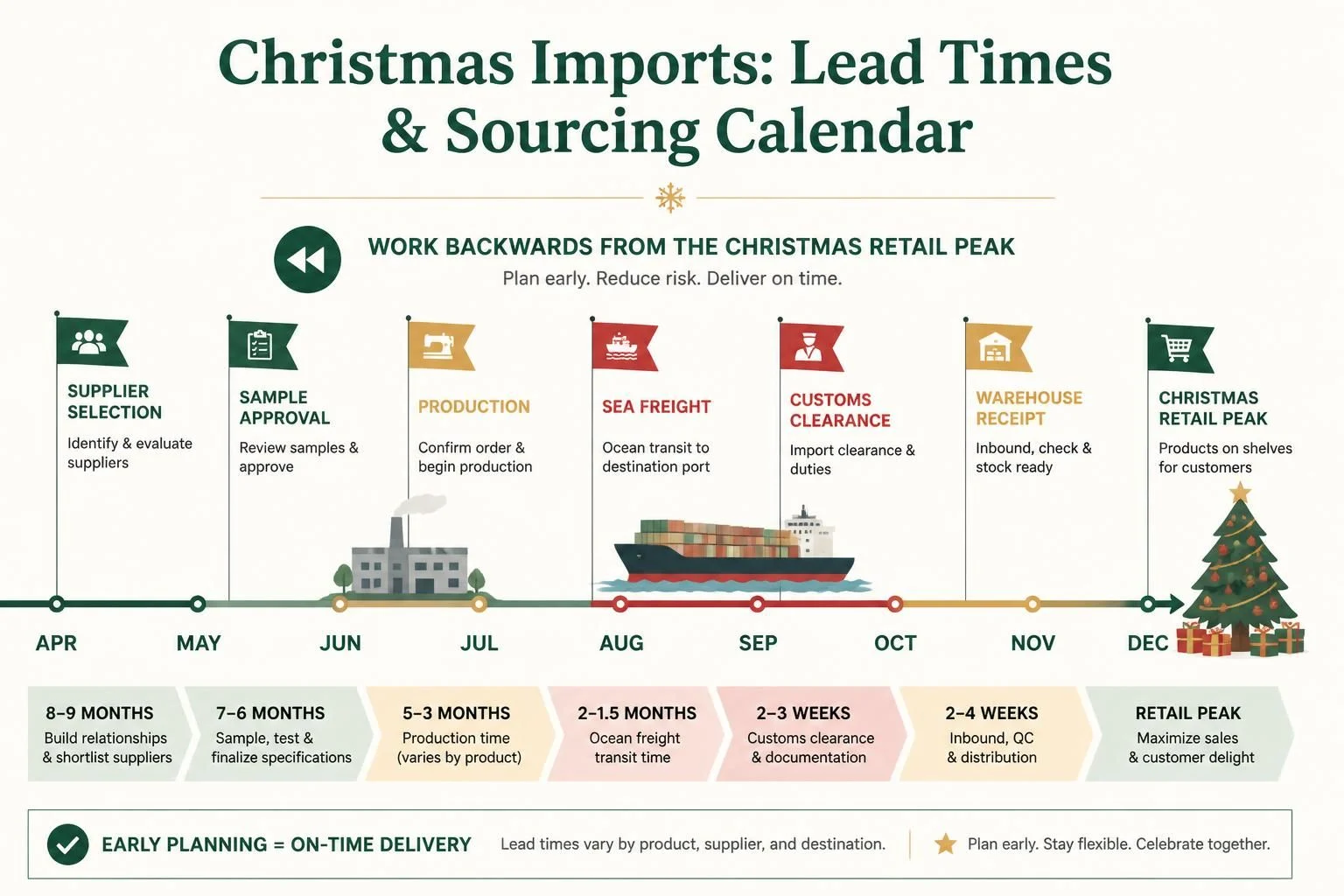
MOQ means minimum order quantity. It changes with material, color, packaging, printing, tooling, and factory capacity. The following are illustrative planning assumptions, not market averages: stock décor may start around 100–500 units, customized ornaments around 500–2,000, printed packaging around 1,000–5,000, and electrical products around 500–2,000. Ask for a price and MOQ ladder instead of one number.
| Activity | Illustrative planning range | What changes it |
|---|---|---|
| Sample preparation | 7–21 days | Existing mold, artwork, lab work |
| Standard production | 20–45 days | Quantity, color, factory load |
| Custom tooling or mold | 45–90+ days | Design revisions, trial runs |
| Inspection and correction | 3–10 days | Defect rate and rework |
| Ocean freight, port-to-port | 25–45 days | Named lane, season, transshipment, quote date |
Source note: MOQ and lead-time figures are illustrative planning assumptions, not market averages. Replace them with a dated supplier quote or anonymized iHome benchmark for the specific SKU, quantity, destination, and customization level.
These figures are working estimates, not measured market averages or guarantees. Before publication, replace them with dated iHome order data or supplier and forwarder quotes where available. A supplier may quote a shorter production time because material is in stock, while the order still needs printed cartons, testing, and inspection. Ask when the clock starts: deposit, sample approval, or artwork approval.
According to the U.S. International Trade Commission, duty treatment depends on the product’s HTS classification, not simply its marketing name (USITC HTS, current). The same principle applies elsewhere: category, material, and use can change the code and import treatment.
How do you vet a Christmas supplier in China?
Verify the legal entity, factory capability, sample consistency, recent compliance evidence, and payment details before any deposit. A six-point supplier file gives you a repeatable minimum check; an Alibaba listing, trade-show business card, or certificate image is only a lead. Request the Chinese business license, factory address, production photos or live video, export experience, and a sample matched to a written specification.
Use a simple six-point supplier file:
- Legal company name and bank-account name.
- Factory or trading-company role, with subcontractors disclosed.
- Product-specific test reports and report numbers.
- Sample photos, measurements, materials, and packaging.
- MOQ, price ladder, production lead time, and capacity for your dates.
- Signed pro forma invoice and agreed Incoterm.
Red flags include a bank-account name mismatch, copied test reports, refusal of a live factory call, pressure to skip samples, and claims that “CE approved” or “FDA approved” covers every market. Pay only after the entity and commercial terms are consistent across the quotation, invoice, contract, and bank instructions.
For a multi-SKU seasonal order, a sourcing partner can compare factories, coordinate samples, and consolidate shipments. iHome’s network includes offices in Ningbo, Yiwu, and Shantou; ask for the actual supplier, sample, and inspection evidence for your order rather than relying on a network statistic alone.
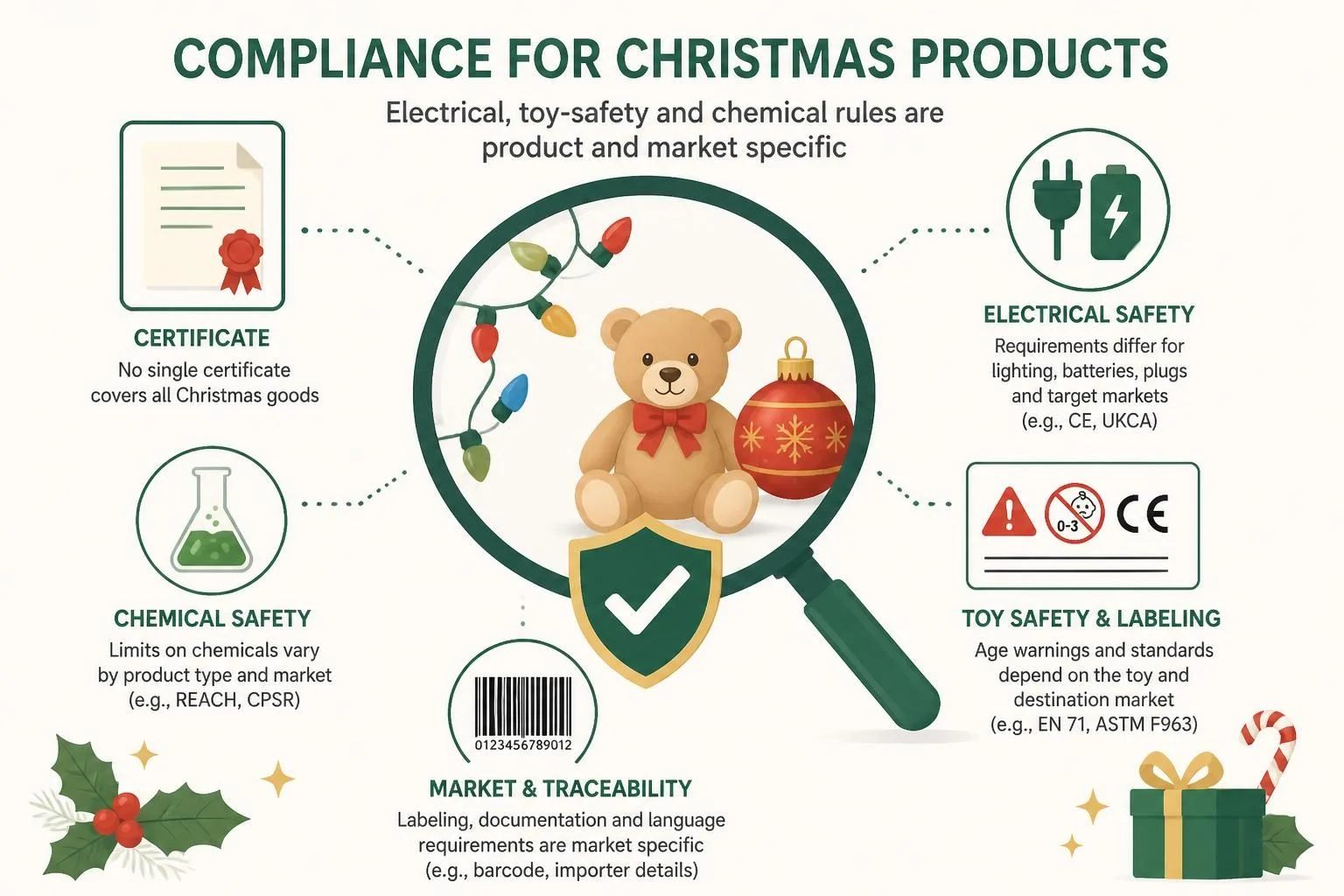
What compliance checks apply to Christmas products?
Compliance depends on the exact product and destination. In the United States, the importer remains responsible for correct entry and duties even when a customs broker files the paperwork, according to U.S. Customs and Border Protection (CBP, current). That is one non-negotiable responsibility: a supplier’s certificate does not transfer it.
United States
- Child-directed products can trigger Children’s Product Certificate and third-party testing requirements under the Consumer Product Safety Improvement Act. Toys commonly require review against ASTM F963; check the current CPSC guidance for the exact product.
- Electrical decorations need evidence appropriate to the product, voltage, plug, and claims. Ask whether a recognized laboratory report, listing, or component documentation is actually required for your channel.
- Wireless or radio-enabled products can involve FCC rules. Battery products add transport, labeling, and packaging questions.
- Confirm textile, fiber, country-of-origin, and packaging claims with the relevant authority before printing cartons.
European Union
The General Product Safety Regulation applies from December 2024 and adds traceability and responsible-person obligations for many consumer products (European Commission, current). CE marking applies only where a specific EU harmonized rule requires it; the European Commission’s CE guidance explains the manufacturer and importer roles (CE marking, current). Depending on the product, also review RoHS, REACH, WEEE, packaging EPR, language, and online listing requirements.
United Kingdom, Canada, and Australia
Rules differ after import. Confirm UK product-safety and labeling requirements for the 2027 product category; do not assume that a CE mark automatically satisfies every UK route. Canadian and Australian electrical, consumer-product, battery, and labeling requirements also depend on the SKU and province or state. A qualified compliance adviser or testing lab should review higher-risk products.
Compliance decision gate: Is it electrical, battery-powered, child-directed, food-contact, cosmetic, or branded? If yes, identify the regulator, test standard, technical file, label, and importer-of-record requirements before production.
How do you calculate landed cost?
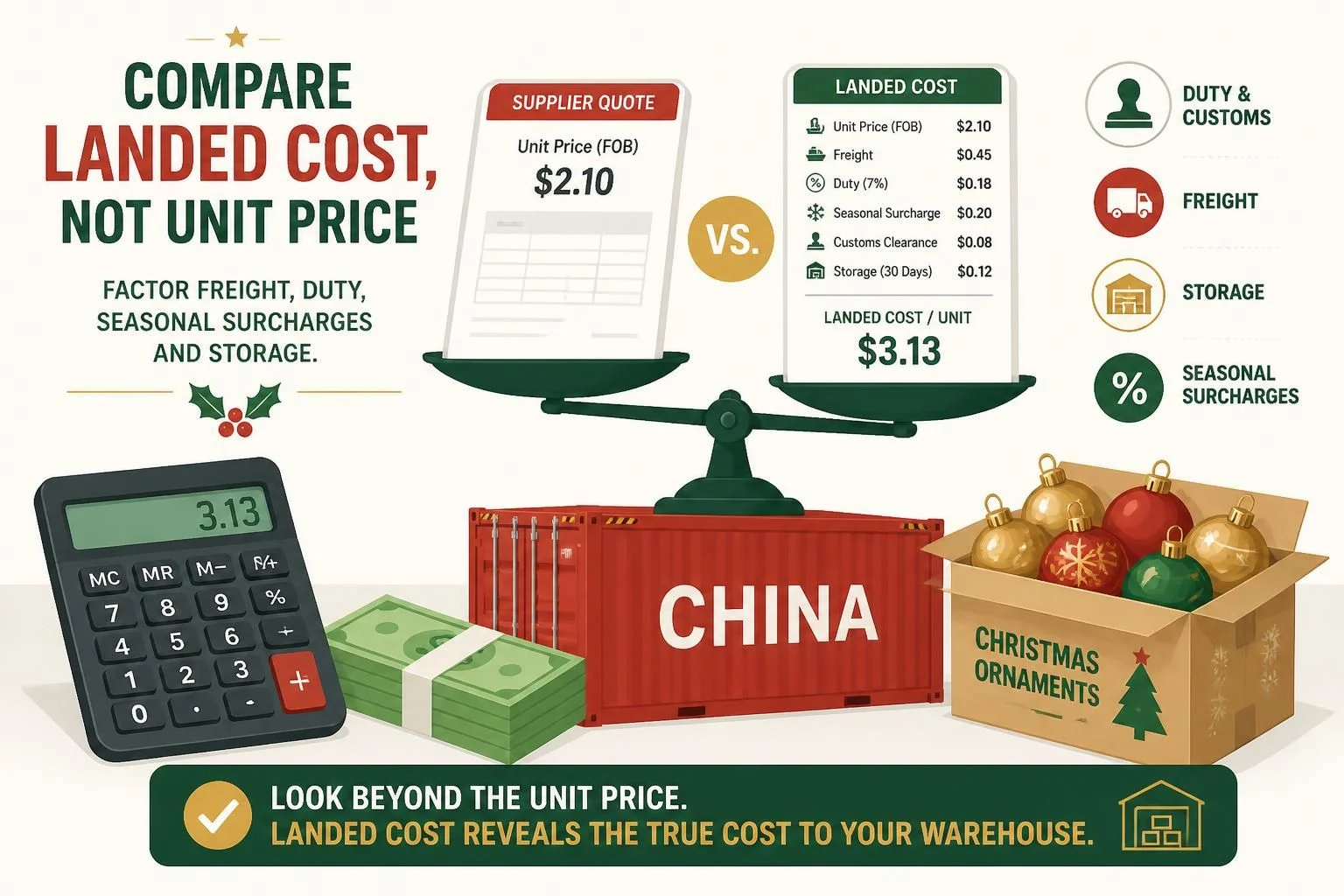
Landed cost has at least 10 common components, from product price through contingency. It is the amount required to get saleable inventory into your chosen warehouse, including customization, packaging, origin charges, inspection, freight, insurance, duty, tax, brokerage, warehouse receiving, and an allowance for defects or returns. A low factory quote can still produce a poor margin.
Use this formula:
Landed cost = product + tooling/customization + packaging + origin charges + inspection + freight + insurance + duty/tax + broker/warehouse + contingency
For a worked model, create inputs for quantity, unit price, carton dimensions, gross weight, Incoterm, origin and destination, HS code, duty rate, tax treatment, inspection scope, and required arrival date. Mark every assumption. Duty rates must be verified for the actual HS code and importing country.
EXW usually leaves more origin work with the buyer. FOB commonly includes delivery to the named origin port. CIF includes ocean freight and insurance to the destination port, but not necessarily customs clearance or final delivery. DDP may simplify coordination, yet you must understand who is importer of record, who pays tax, and which documents you receive.
Which inspection and packaging controls prevent failures?
Use a golden-sample approval before production and a pre-shipment inspection before release. For custom or large seasonal orders, add a production check. AQL is a sampling method, not a substitute for a clear defect definition, safety test, or packaging requirement.
Check color and finish consistency, glitter or surface shedding, ornament breakage, light function, plug and wire details, battery packaging, carton drop resistance, barcode placement, master-carton counts, and country-of-origin labels. Require photo evidence and a corrective-action deadline for failed checks.
The inspection report should identify the factory, SKU, lot size, sampling plan, defects, photos, and release decision. Keep the approved sample, artwork version, test reports, and inspection report together. That file is more useful than a supplier promise made in a chat message.
How should you ship Christmas products to arrive before the season?
Choose transport based on the order: ocean freight for planned volume, LCL for smaller tests, and air or express for samples or urgent replenishment. Ocean transit figures often describe port-to-port movement. Total time also includes production, inspection, booking, origin handling, customs clearance, final-mile delivery, and warehouse receiving.
Build a milestone sheet with cargo-ready date, inspection release, booking confirmation, ETD, ETA, customs documents, customs release, delivery appointment, and warehouse check-in. Ask the forwarder for the quote validity period and the assumptions behind fuel, peak-season, and destination charges.
If an order is late, reduce SKU count before you simply upgrade every carton to air. A smaller launch quantity by air, followed by the balance by sea, may protect the selling window while limiting the margin hit. Calculate the difference before approving the change.
For product discovery, see iHome’s Canton Fair sourcing support. For consolidation and delivery planning, use the China logistics and freight coordination service page. You can also download the product catalog before building your shortlist and review why choose iHome for the company’s sourcing process and credentials.
What should be in the purchase order?
The purchase order should make at least 15 commercial and quality fields explicit. Include the SKU and revision, materials, dimensions and tolerances, color references, artwork approval, carton marks, quantity tolerance, MOQ, currency, Incoterm and named place, payment schedule, inspection rights, defect or rework terms, IP ownership, compliance documents, delivery date, and late-delivery escalation.
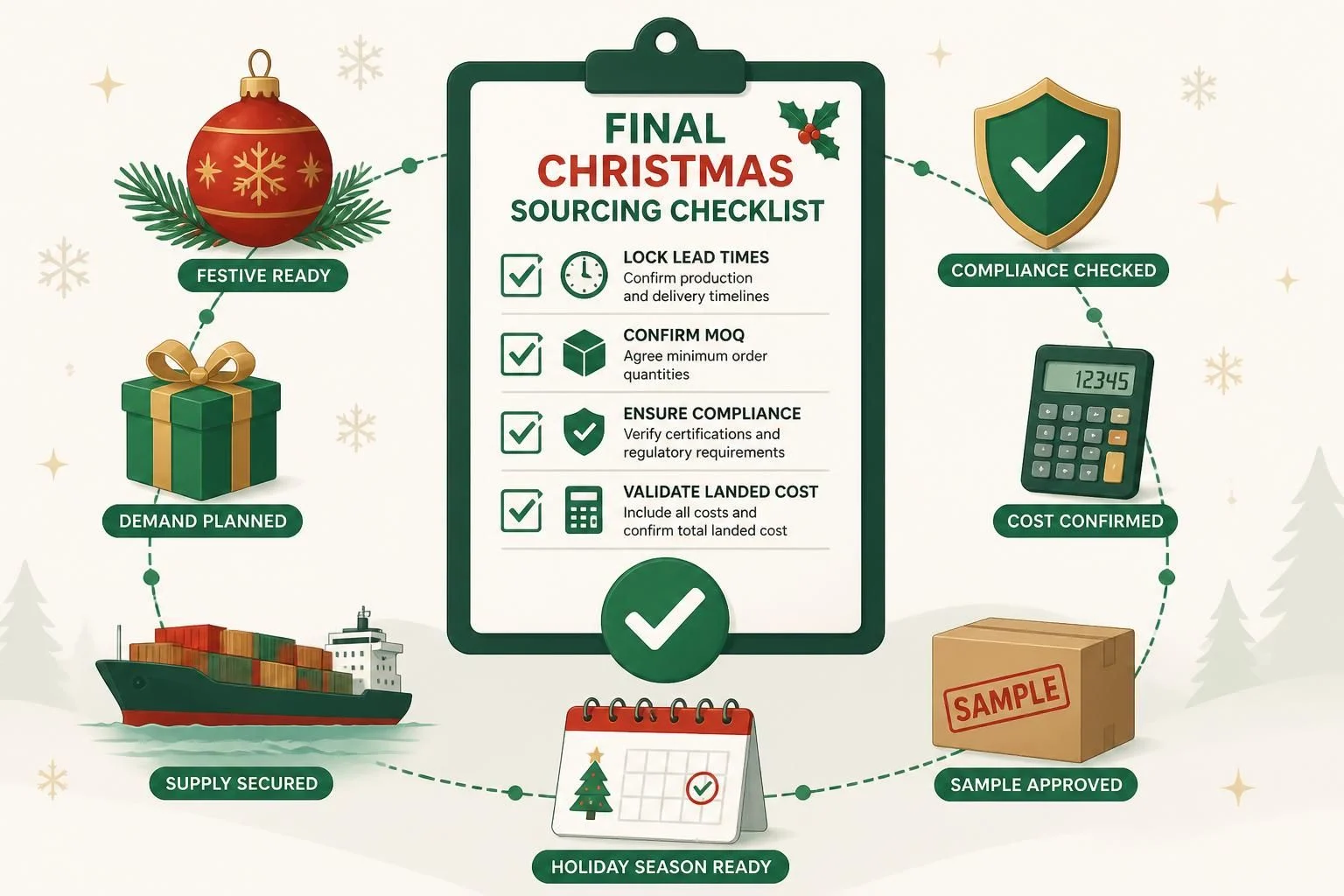
Before paying a deposit, confirm five gates:
- The product is legally importable in the destination market.
- The supplier’s entity and bank details match.
- The sample and specification are approved in writing.
- The landed-cost model includes duty, tax, freight, inspection, and contingency.
- The production slot, inspection date, and arrival buffer are documented.
For material orders, obtain local legal and compliance advice. Contract terms, tax treatment, and customs obligations differ by country.
How can you reduce Christmas 2027 risk?
Split risk across five areas: timing, supplier, compliance, cash, and demand. Test a smaller quantity, dual-source critical SKUs, reserve a 2–4 week schedule buffer where possible, and keep a documented decision date for every open issue. Do not let a low price erase the cost of a missed season.
Only publish a first-hand iHome case note here when the sourcing manager, date range, product category, and outcome are documented and approved for publication. A useful note would identify the specific control that changed the outcome, such as locking carton artwork and the golden sample before production; do not substitute an invented client result.
When you request help, include product links or photos, destination country, target quantity, budget, required in-market date, packaging needs, and any testing already completed. iHome can then evaluate the supplier route, sample plan, quality checks, and freight options against the actual deadline.
Frequently Asked Questions
How early should I order Christmas products from China for 2027?
In the example calendar, start discovery in January or February, approve samples by March or April, and target May or June production orders for standard goods. Add an illustrative 2–4 week contingency after checking your lane and launch date. Custom molds, electrical products, testing, and destinations with longer clearance may require an earlier start; confirm this with suppliers and advisers.
What is a realistic MOQ for Christmas decorations?
Planning ranges vary. Stock décor may begin around 100–500 units; customized ornaments often start around 500–2,000; printed packaging can require 1,000–5,000. The factory, material, colors, packaging, and customization determine the real MOQ, so request a price ladder.
Do Christmas lights need certification?
Often they need product- and destination-specific safety and electrical documentation, but there is no universal certificate. In the US, check applicable CPSC, electrical, FCC, and labeling requirements. In the EU, review the relevant CE legislation, technical file, and importer obligations before production.
Can I use DDP for Christmas imports?
DDP can simplify coordination, but ask who is importer of record, who pays duty and tax, and what customs documents you receive. The importer still needs a compliant product and accurate commercial information. Compare DDP with FOB or CIF using the same landed-cost assumptions.
How long does sea freight from China take?
Ocean transit may take roughly 25–45 days port-to-port in this illustrative planning model, but total delivery is longer. Add production, inspection, booking, origin handling, customs clearance, final-mile delivery, and warehouse receiving. Ask the forwarder for a lane-specific quote, quote date, validity period, and assumptions instead of relying on a generic transit promise.
Is Yiwu a good place to source Christmas products?
Yiwu offers broad seasonal assortment and useful sampling opportunities. It can be a good discovery route for décor and gift items, but market availability does not prove repeat-production capacity. Verify the actual factory, specifications, packaging, compliance evidence, and replenishment plan before placing a seasonal order.
Plan the 2027 order before the season plans you
The workable Christmas sourcing plan is straightforward: choose a product with manageable risk, verify the supplier, approve the sample and compliance file, calculate landed cost, inspect production, book freight early, and protect the arrival buffer. Keep the dates and assumptions visible to everyone involved.
Ready to compare suppliers or build a seasonal order plan? Start a Free Inquiry with your product, destination, quantity, budget, and required in-market date.

Gong Zheng is a blog editor for iHome, focusing on global sourcing, wholesale market trends, and practical advice for international buyers. Drawing on extensive experience in digital marketing and cross-border trade, he shares expert insights to help small and medium-sized enterprises source products more efficiently and avoid common pitfalls. Passionate about connecting buyers with reliable suppliers, he writes in a clear, approachable style that makes complex topics easy to understand.